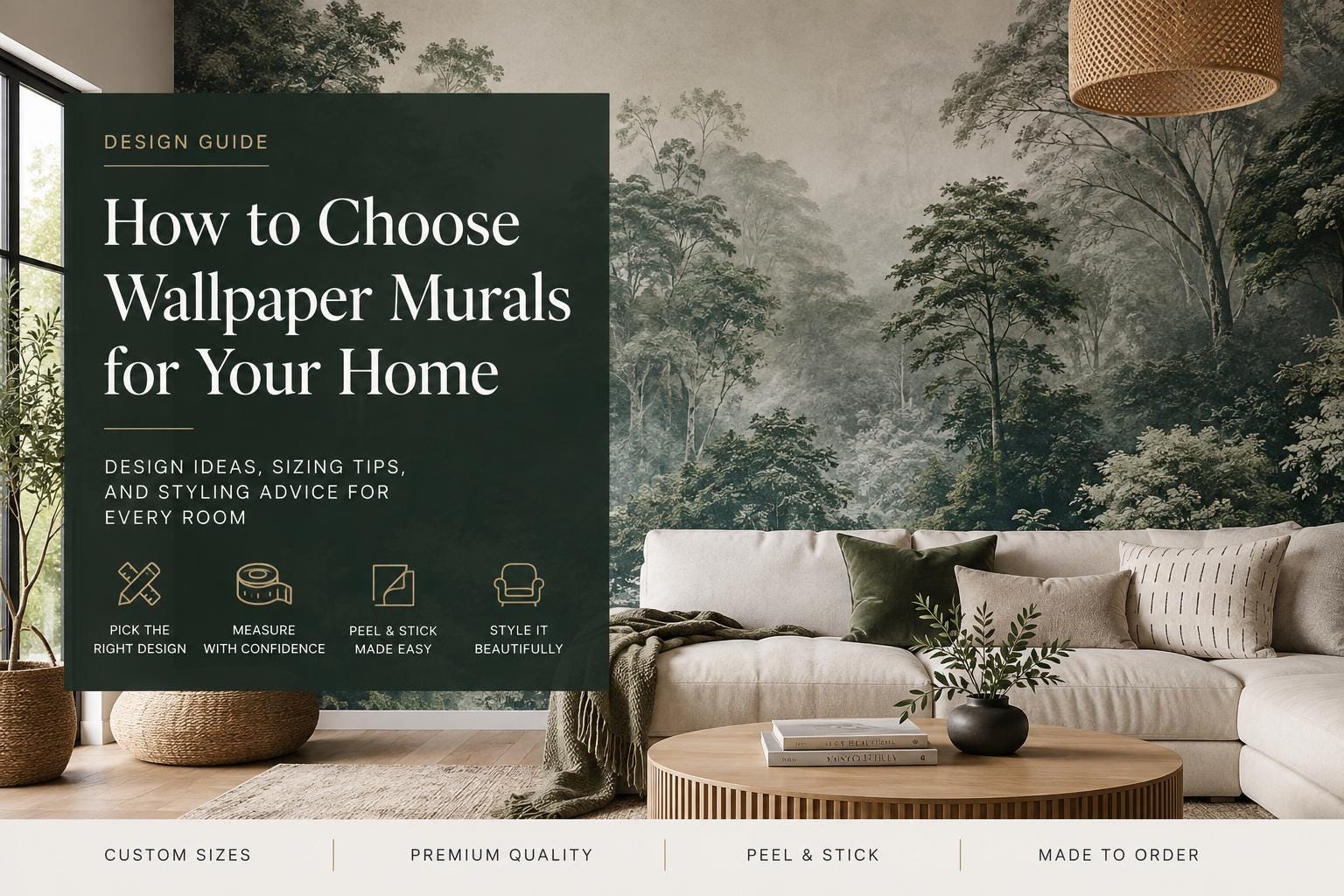
A blank wall can make even a well-furnished room feel unfinished. Wallpaper murals solve that problem with one intentional visual move: a misty forest behind the bed, oversized peonies in a dining nook, a city map in a home office, or a child’s name set among stars. Rather than decorating around a wall, you let the wall establish the room’s mood.For homeowners, renters, and anyone avoiding a full renovation, peel-and-stick murals offer a particularly practical route to a custom-looking space. The key is choosing a design and scale that fit the room, measuring carefully, and starting with a wall surface that gives the adhesive the smooth, clean foundation it needs.
What Makes Wallpaper Murals Different?
A repeating wallpaper pattern is designed to continue across a wall or around an entire room. A mural is a complete scene, artwork, or large-scale composition made for a specific wall size. It may be subtle, such as a tonal watercolor landscape, or it may be the main event, such as a dramatic tropical jungle, vintage floral garden, or celestial sky.That distinction changes how you decorate. With a mural, the furniture and lighting should support the image rather than compete with it. A moody botanical mural can give a bedroom the character of a boutique hotel with simple linen bedding and warm lamps. A playful safari scene can make a nursery feel considered before you add more than a crib, rug, and a few meaningful accessories.Made-to-order wallpaper murals also eliminate much of the guesswork that comes with trying to make standard rolls work on an unusual wall. Custom dimensions allow the design to be produced for your space, whether you are covering a narrow entry wall, an expansive living room feature wall, or the wall behind a desk in a compact home office.
Start With the Room’s Job
The best mural is not simply the prettiest design on a screen. It needs to suit what the room does and how you want to feel in it.A bedroom usually benefits from designs with visual depth and a calmer rhythm. Soft florals, hazy landscapes, muted abstract forms, and moonlit celestial motifs can create a restful backdrop without making the space feel busy. If you are choosing a darker color palette, balance it with bedding, curtains, or nightstands that bring in lighter tones.Living rooms and dining rooms can handle more drama. Large botanical leaves, rich vintage florals, marble-inspired abstraction, or luxury-inspired patterning work beautifully where people gather. Here, a mural often looks strongest on the wall behind a sofa, dining table, or console. It gives the room a clear focal point and makes the furniture arrangement feel anchored.For home offices, consider the camera angle as well as your own view. A refined map, architectural city scene, abstract neutral design, or tailored monogram mural can make video calls look more polished while giving the workspace a sense of purpose. Avoid a design with tiny, high-contrast details directly behind your chair if it will appear on camera often.Children’s spaces invite more personality. Whimsical animals, outer space, enchanted forests, soft rainbows, and personalized name murals create a setting that feels special without requiring a room full of themed furniture. A mural can grow with a child more gracefully than a short-lived character trend, especially when you choose a color palette that works with adaptable basics.
Choose a Scale That Works With Your Wall
Scale is where a mural can feel spectacular or slightly off. On a wide wall, a design with expansive scenery, oversized blooms, or open sky has room to breathe. On a narrow wall, look for artwork with a strong central element or a composition that does not rely on a distant subject being visible across a large width.Consider what will cover the lower portion of the wall. A headboard, sofa, bookcase, crib, or desk can conceal meaningful details if the artwork is not positioned with furniture in mind. This does not mean the wall must stay empty. It means you should select a mural whose most striking features remain visible above and around the furniture.Ceiling height matters, too. Vertical tree trunks, tall arches, climbing florals, and sky scenes can emphasize height in rooms with standard ceilings. In a low-ceilinged space, designs with a strong horizontal sweep can make the room feel wider instead. If your room has sloped ceilings, windows, or an off-center doorway, custom sizing is especially helpful because it gives you a better starting point than a one-size-fits-all roll.
Color on a Screen Is Only a Starting Point
The same mural can look different in a bright, south-facing room than it does in a shaded hallway. Wall color nearby, flooring undertones, and warm or cool light bulbs all affect what you see. This is why samples are worth ordering before committing to a full made-to-order mural.Place a sample on the intended wall and look at it in morning light, afternoon light, and after dark with your regular lighting on. Pay attention to the background color as much as the artwork itself. A cream that reads warm online may look cooler beside gray flooring, while a deep green can appear nearly black in a dim room. A sample also lets you assess material texture and adhesion on your particular surface.
Measure Before You Fall in Love With the Design
A mural should be ordered from the actual width and height of the wall, not the dimensions you hope it is. Measure the width in more than one place, since older homes and imperfect corners are rarely perfectly square. Measure the height on both sides as well.Add a small amount of extra material for trimming at the ceiling, baseboard, and edges. That extra margin is what helps achieve a clean finish when walls are slightly uneven. Record obstructions such as windows, doors, outlets, vents, and built-ins before ordering, particularly if the mural contains a centered subject, name, quote, or map.Personalized wallpaper murals deserve an additional pause before purchase. Check name spelling, punctuation, capitalization, and placement details carefully. Because made-to-order products are created specifically for your selection and dimensions, they are generally not returnable for a change of mind or a measurement error. Taking five focused minutes before checkout is far easier than trying to solve an avoidable sizing issue later.
Know When Peel-and-Stick Is the Right Choice
Peel-and-stick wall murals are designed to make a major visual update more accessible. You do not need paste, a professional installer, or a weekend spent cleaning adhesive off every surface. For renters and commitment-conscious decorators, the removable format can be a major advantage when used on an appropriate wall.The surface matters. Smooth, clean, dry, properly cured walls provide the best adhesion. Freshly painted walls need adequate curing time before installation, and textured walls, dusty surfaces, peeling paint, heavy orange-peel texture, and moisture-prone areas can compromise the result. If you are unsure about your wall finish, test a sample first rather than assuming every painted wall performs the same way.Installation is easier with patience than speed. Clean the wall, plan your panel order, align the first panel carefully, and smooth gradually as you apply. The first panel sets the direction for everything that follows, so taking extra time at the start is worthwhile. A second set of hands is useful for tall panels or wide murals, but a thoughtful DIY approach is often enough for a smooth-wall project.
Style It Like a Finished Room, Not a Photo Backdrop
Once the mural is up, resist the urge to match every object to it exactly. Pull two or three colors from the design and repeat them through pillows, throws, art, or a rug. Let the mural remain the visual statement while the rest of the room adds texture and comfort.A dark or detailed mural often benefits from simpler furniture silhouettes and open space around it. A pale, airy mural can support more layered textiles, natural wood, and decorative accents. If the wall feels overwhelmingly bold at first, give the room a day or two before changing course. Large-scale art naturally asks for an adjustment period, and it often settles into the room once furniture and lighting are in place.WallpaperCraftWorks murals are made for decorators who want that high-impact shift without treating their home like a construction site. Choose a design that feels personal, order for the wall you actually have, and let one well-chosen surface make the rest of the room feel more like yours.