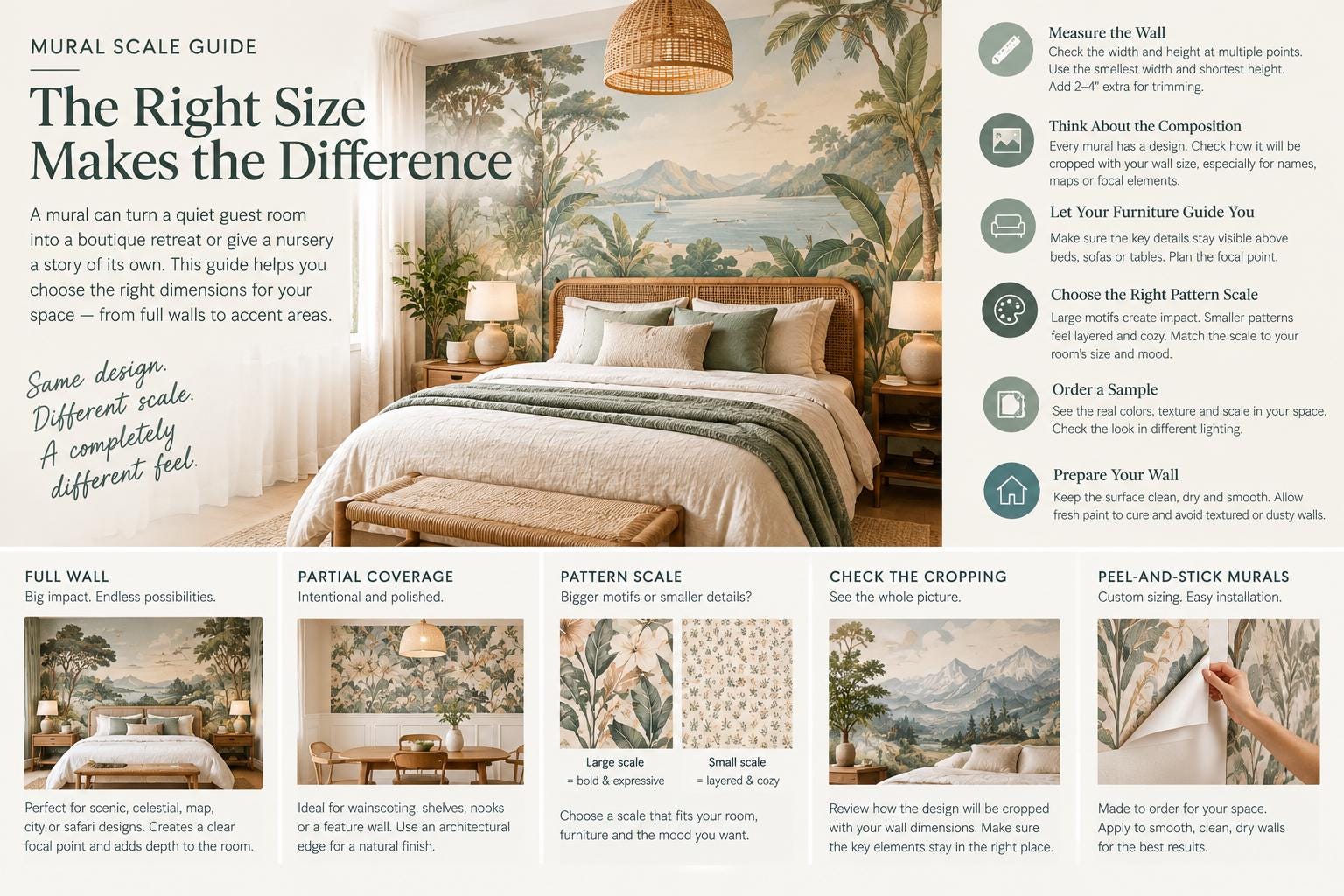
A mural can make a quiet guest room feel like a boutique retreat or turn a plain nursery into a place with its own story. But the same design can feel dramatically different depending on its size. This mural scale guide helps you choose dimensions that feel intentional in your room, whether you are covering one focused accent wall or creating a fuller, immersive backdrop.For made-to-order peel-and-stick murals, scale is not an afterthought. It is part of the design decision. Your wall measurements determine how the artwork is cropped, where its most beautiful details land, and whether the finished wall feels expansive rather than crowded.
Start With the Wall, Not the Room
The most reliable way to choose mural dimensions is to measure the exact surface you plan to cover. A large living room does not always need a large mural, and a small bedroom can still carry a bold design beautifully. What matters first is the usable wall area.Measure the width at the top, middle, and bottom of the wall. Older homes and newly finished spaces alike can have walls that are slightly out of square. Use the smallest width measurement for a cleaner fit. Then measure the height in a few places, from the baseboard or floor to the ceiling, and use the shortest height.For a custom mural, add a little extra material to both measurements. An additional 2 to 4 inches in width and height gives you room to trim precisely around ceilings, baseboards, and corners. This small allowance is especially helpful when walls are not perfectly straight. Ordering a mural at the exact wall dimensions can leave you short at one edge, even if your measuring was careful.Obstacles such as windows, doors, outlets, vents, and built-in shelving do not usually need to be subtracted from the overall wall size. The mural is installed as a full field and trimmed around those features. The exception is a wall broken into separate, narrow sections. In that case, treat each section as its own visual area and consider whether a mural will read clearly across the interruptions.
Mural Scale Guide: Match Size to Visual Impact
A mural does more than fill wall space. It changes the perceived proportions of the room. Large-scale palms, oversized florals, sweeping clouds, and abstract brushwork create a stronger sense of movement and depth. Smaller motifs can feel quieter, more detailed, and easier to layer with patterned bedding, rugs, or window treatments.
Full-Wall Murals Create the Strongest Statement
Covering an entire wall is often the best choice for scenic, celestial, map, city, or safari designs. A full-wall installation lets the artwork feel continuous, so a misty mountain range can stretch behind a bed or a playful jungle scene can surround a child's reading nook without looking like a framed image enlarged beyond its purpose.Full-wall scale works particularly well behind a bed, sofa, dining table, crib, or desk. The furniture grounds the composition while the mural gives the room a clear focal point. In a home office, a custom city map or rich abstract mural behind your desk can give video-call backgrounds more personality without adding visual clutter to the work surface.For a short wall, a full-height mural can still be the right proportion. Height often creates more impact than width, especially in entryways, powder rooms, or narrow alcoves. A vertical botanical pattern or star-filled sky can make the ceiling line feel higher and the space feel more considered.
Partial Coverage Needs a Clear Edge
A mural does not have to cover every inch of the wall. A partial mural can work well above wainscoting, behind open shelving, inside a recessed nook, or as a defined feature above a console table. The key is making the stopping point look deliberate.If you plan to cover only part of a wall, use an architectural boundary whenever possible. A corner, chair rail, bookshelf edge, or paint-color break creates a natural finish. Stopping a mural in the middle of an uninterrupted wall can look accidental unless the design is intentionally framed with molding or paired with a strong painted border.Partial murals are also useful when a room already has an active mix of materials. If you have paneled lower walls, dramatic tile, or a large gallery arrangement, a smaller mural section can add color and character without competing for attention.
Consider the Furniture in Front of the Mural
Furniture does not need to disappear against a mural, but it should not hide the entire reason you chose it. Before ordering, picture where the main visual elements will fall behind your furniture.A bed usually covers the lower third to half of the wall, depending on the headboard. Choose designs with meaningful detail higher in the composition, such as floating florals, birds, clouds, moons, treetops, or an open horizon. For personalized name murals, make sure the name sits above the crib, headboard, or changing table rather than directly behind it.Behind a sofa, keep the most interesting section of the pattern visible above the sofa back. A low-back sofa leaves more room for a large landscape or oversized botanical composition. A tall sectional may call for a bolder upper-scale print, or a mural with detail that continues toward the ceiling.In dining spaces, mural scale can be more flexible because tables and chairs tend to sit lower. This is a good setting for fuller scenes, repeating patterns, or luxury-inspired designs that bring a polished feel to dinners, celebrations, and everyday coffee.
Choose a Pattern Scale That Fits the Room's Mood
The physical size of the mural and the size of the artwork within it are related, but they are not the same. A full-wall mural can feature delicate small-scale details. A narrow accent wall can showcase one oversized bloom or abstract shape.Large motifs are excellent for rooms where you want immediate impact. Think oversized peonies in a primary bedroom, bold arches in an entryway, or large jungle leaves in a vacation rental powder room. They are graphic, expressive, and often photograph beautifully. The trade-off is that they need a little breathing room. A wall crowded with tall furniture, busy decor, and multiple competing colors may be better suited to a softer or more open design.Smaller, repeating motifs bring a more layered, collected look. They work well in nurseries, reading corners, laundry rooms, and bedrooms with patterned textiles. A small-scale print can also be forgiving on walls with several doors, windows, or angles because the repeat remains visually consistent after trimming.For compact rooms, do not assume you have to choose tiny patterns. A larger motif with a light background, open spacing, or receding scenery can make a small room feel less boxed in. Darker murals can be equally beautiful in smaller spaces when you want a cozy, enveloping mood, particularly in bedrooms, dens, and powder rooms.
Check Cropping Before You Commit
Every mural design has a composition. Some are designed as all-over patterns with flexible cropping, while others have a central focal point, horizon line, map label, animal grouping, or personalized detail that needs thoughtful placement.Review the design with your final wall dimensions in mind. A wide, short wall may crop more from the top and bottom of a portrait-oriented scene. A tall, narrow wall may trim from the sides of a landscape. Neither is automatically a problem, but it can change what the design emphasizes.This matters most for murals featuring names, initials, quotes, city skylines, maps, or recognizable scenic elements. If your wall includes a door on one side or a large headboard below, plan around it. The goal is not to preserve every inch of the original artwork. The goal is to preserve the part that will make your wall feel special.At WallpaperCraftWorks, custom sizing makes it easier to select dimensions that fit your actual wall rather than forcing your room to work around standard wallpaper rolls. Because murals are made to order, confirm your measurements, surface choice, and design layout before placing the order. Made-to-order wallcoverings are created specifically for your space, so careful planning upfront is worth it.
Use a Sample to Judge Scale and Color at Home
A sample is helpful for more than checking whether you like the color. Place it on the intended wall and view it from the doorway, from where you sit, and in both daylight and evening lighting. This gives you a more realistic sense of the print's scale against your flooring, furniture, and trim.A sample cannot show an entire mural composition, but it can reveal whether the background feels too warm, whether a metallic-inspired print has the right level of contrast, or whether the texture and adhesion suit your smooth wall. It is a simple way to make a confident choice before ordering a larger custom piece.
Keep Installation Conditions in Mind
Even the best mural scale will not look polished on an unsuitable surface. Peel-and-stick wall murals perform best on clean, dry, smooth walls. Fresh paint needs adequate curing time, and heavily textured walls, dusty surfaces, peeling paint, or moisture-prone areas can affect adhesion.When measuring, include wall height all the way to the planned finish point, but think through your installation path too. Taller murals may require a second set of hands, a step stool, and a little extra time to align each panel carefully. That is not a reason to avoid a full-height look. It simply helps you prepare for a smoother DIY project.A well-scaled mural should feel like it belongs to the room from the moment you walk in. Measure with a little margin, let your furniture guide focal placement, and choose a design scale that supports the mood you want to live with every day.