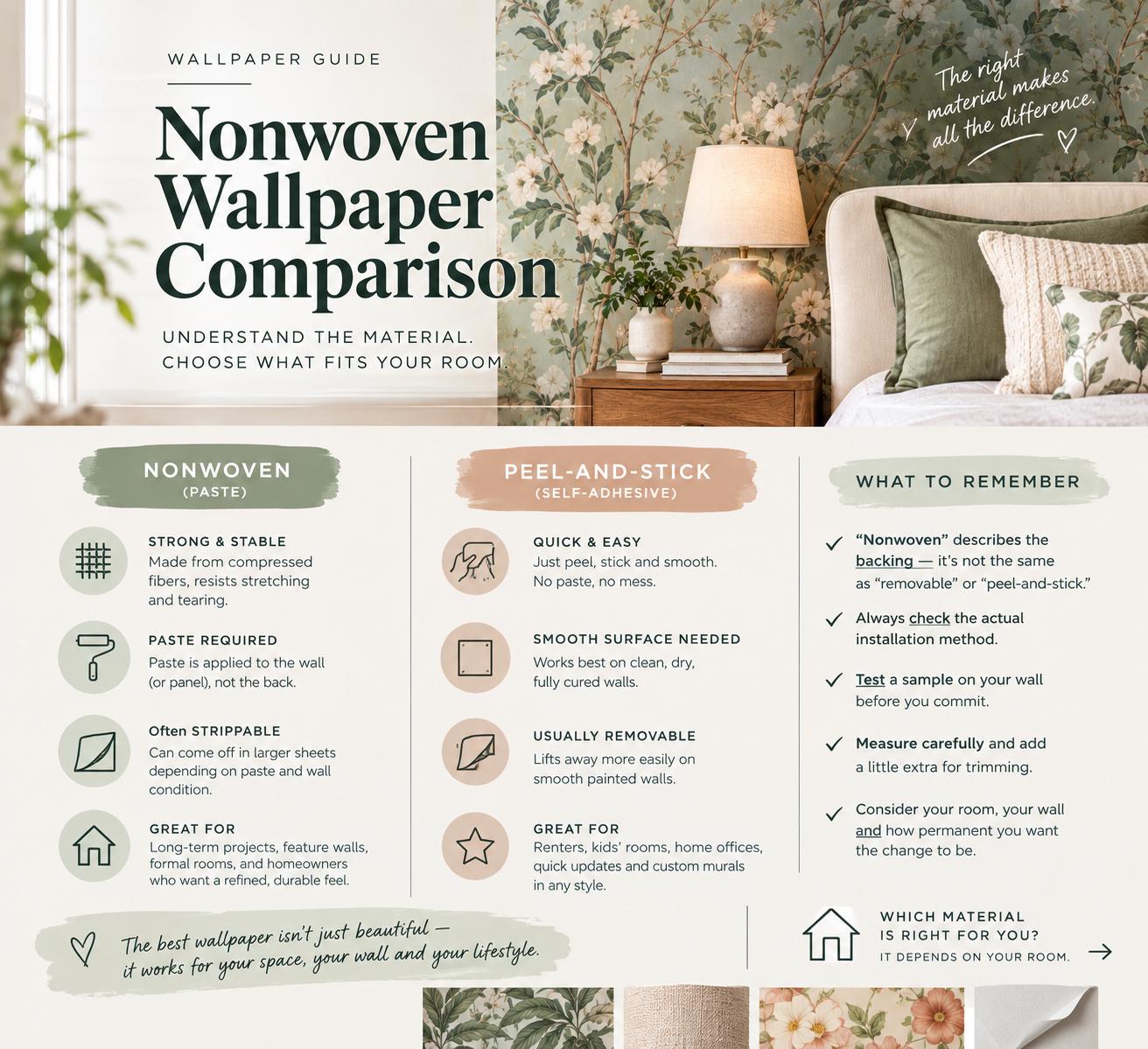
A dramatic wallpaper print can make a plain bedroom feel considered, give a home office a point of view, or turn a nursery into a place your child remembers. But before choosing a pattern, a nonwoven wallpaper comparison helps answer the practical question behind the look: will this material work with your wall, your installation comfort level, and your plans for the room?Nonwoven wallpaper is popular for good reason, but it is not automatically the best choice for every project. The key is understanding what “nonwoven” describes, how it differs from peel-and-stick and traditional paper, and where each option makes sense.
What nonwoven wallpaper actually means
Nonwoven wallpaper refers to the backing or substrate of the wallcovering. Rather than being made from a single sheet of paper, it is typically formed from compressed synthetic and natural fibers. This gives the material a fabric-like stability while helping it resist stretching, shrinking, and tearing more effectively than many traditional paper wallpapers.Most nonwoven products are installed with paste. Depending on the product, paste may be applied directly to the wall rather than to the wallpaper panel. That can make the process cleaner than older paste-the-paper methods, especially when matching a repeating design across several strips.Still, “nonwoven” does not mean the same thing as “removable” or “peel-and-stick.” A wallpaper can have a nonwoven backing and require paste. A self-adhesive wallpaper uses an adhesive backing that is exposed by removing a liner. When comparing products, look beyond the material label and confirm the actual installation method.
Nonwoven wallpaper comparison: nonwoven vs. peel-and-stick
For most homeowners and renters shopping for a quick visual transformation, this is the comparison that matters most. Both options can deliver a polished accent wall, but the installation experience is different.
Installation and adjustment
Pasted nonwoven wallpaper asks for more preparation. You will need wallpaper paste, a smoothing tool, a sharp blade, and a clean work area. Paste-the-wall nonwoven products can be more manageable than traditional paper, but they still involve wet adhesive, trimming, and a little patience while you position each panel.Peel-and-stick wallpaper arrives with the adhesive already in place. You line up the top edge, peel the backing gradually, smooth as you go, and trim the excess. It is a more approachable route for first-time DIY decorators who want a weekend project rather than a wallpapering lesson.That convenience comes with a condition: self-adhesive wallpaper needs a properly prepared surface. Smooth, clean, dry, fully cured walls offer the best grip. Walls with heavy texture, loose paint, dust, fresh paint, or moisture issues can compromise adhesion. A peel-and-stick product is simple to install on the right wall, not every wall.
Removability and rental flexibility
Nonwoven pasted wallpaper is often marketed as strippable, meaning it may pull away in larger sheets when it is time to redecorate. The result depends on the paste used, wall preparation, paint quality, and how long the wallpaper has been installed. Strippable is helpful, but it should not be read as a promise of damage-free removal in every situation.Peel-and-stick wallpaper is usually the more flexible choice when you want a lower-commitment update. On a sound, smooth painted wall, it can generally be lifted away without the soaking and scraping associated with permanent wallcoverings. That makes it especially appealing for renters, changing kids’ rooms, vacation rentals, and anyone who likes to refresh a space as their style evolves.If the wall has weak paint, existing damage, or an unknown paint history, no removable product can guarantee a perfect outcome. Test a sample first and inspect the condition of the surface honestly before committing to a full wall.
Finish, feel, and design impact
A nonwoven wallpaper can offer a refined, substantial feel and is available in many decorative finishes. It may suit a formal dining room, a carefully styled primary bedroom, or a long-term home renovation where you are comfortable working with paste.Peel-and-stick wallpaper is not a lesser design choice. High-impact murals, lush botanicals, modern abstracts, celestial skies, and personalized designs all translate beautifully in a self-adhesive format. The difference is more about the installation system and surface requirements than whether your finished room can look elevated.For an accent wall, a self-adhesive mural can be particularly effective because it is custom-produced for the wall’s dimensions. You are working with planned panels rather than trying to make standard rolls fit a space that is anything but standard.
How traditional paper and vinyl compare
Traditional paper wallpaper has a classic appeal, but it is less forgiving during installation. It can stretch when wet and may shrink as it dries, making seam alignment more demanding. It is typically better suited to experienced installers or homeowners who are prepared for a more hands-on project.Vinyl wallpaper is often chosen for durability and cleanability. It can be a practical candidate for some high-traffic areas, but there are several types of vinyl wallcovering, from solid vinyl to vinyl-coated paper, and they do not all behave alike. Some can feel heavier or less breathable than nonwoven options. In humid spaces, the larger concern is not just the wallpaper material but whether the wall is dry, stable, and properly ventilated.For a powder room with good ventilation, a wipeable surface may be useful. For a bedroom feature wall where softness, color, and easy future change matter most, peel-and-stick may be the more natural fit. The right choice depends on the room’s real conditions, not just its style.
Choose based on your room, not just the pattern
A beautiful print should work with the way you live. Start by asking how permanent the change needs to be. If you are creating a forever dining room, pasted nonwoven wallpaper may feel worthwhile. If you are styling a rental bedroom, updating a home office backdrop, or designing a child’s room that will change in a few years, removable self-adhesive wallpaper gives you more freedom.Then assess the wall itself. Flat painted drywall is the friendliest surface for peel-and-stick installation. Light orange-peel texture may show through fine details or reduce adhesion, while deep texture, brick, unprimed drywall, and damaged surfaces are poor candidates. A dark paint color may also affect the appearance of pale designs if the wallpaper is not fully opaque.Finally, consider the scale of the design. Tiny repeating prints can add texture to a full room, while oversized florals, maps, jungle scenes, and abstract murals often shine on one focal wall. A custom-sized design helps avoid awkward cropping around windows, doors, and furniture.
The sample is part of the decision
A screen cannot show every detail that matters in your home. Color shifts with daylight, warm bulbs, and the surrounding furnishings. A sample lets you see whether a soft sage botanical reads green or gray in your bedroom, whether a blush floral feels warm against your trim, and whether a navy celestial print gives your room the depth you wanted.It also gives you a practical adhesion test. Apply the sample to the exact wall after cleaning it and allowing it to dry completely. Leave it in place long enough to observe how it holds, then remove it carefully. This small step is especially valuable on rental walls, recently painted walls, or surfaces with an uncertain finish.Because made-to-order wallpaper is produced specifically for your selected size and design, measuring deserves the same care as choosing the pattern. Measure the wall width and height at more than one point, account for any unusual angles or sloped ceilings, and round according to the seller’s measuring guidance. Ordering too little is harder to solve than having a modest allowance for trimming.
When peel-and-stick is the smarter choice
Peel-and-stick is often the most practical option when your priority is a design-forward update without paste, professional installation, or a long-term renovation commitment. It suits smooth walls in bedrooms, nurseries, entryways, living rooms, home offices, and photo-ready rental spaces particularly well.WallpaperCraftWorks designs are made to order in custom dimensions, which helps homeowners create a more intentional fit for their space. That said, custom production also means you should confirm your measurements, review the design scale, and use a sample when color or surface compatibility is uncertain. Thoughtful preparation is what makes a DIY installation feel easy rather than rushed.The best wallcovering is the one that supports both your vision and your real-life needs. Choose the material that fits your wall, give yourself time to measure and sample, and let the final design do what great wallpaper does best: make the room feel unmistakably yours.