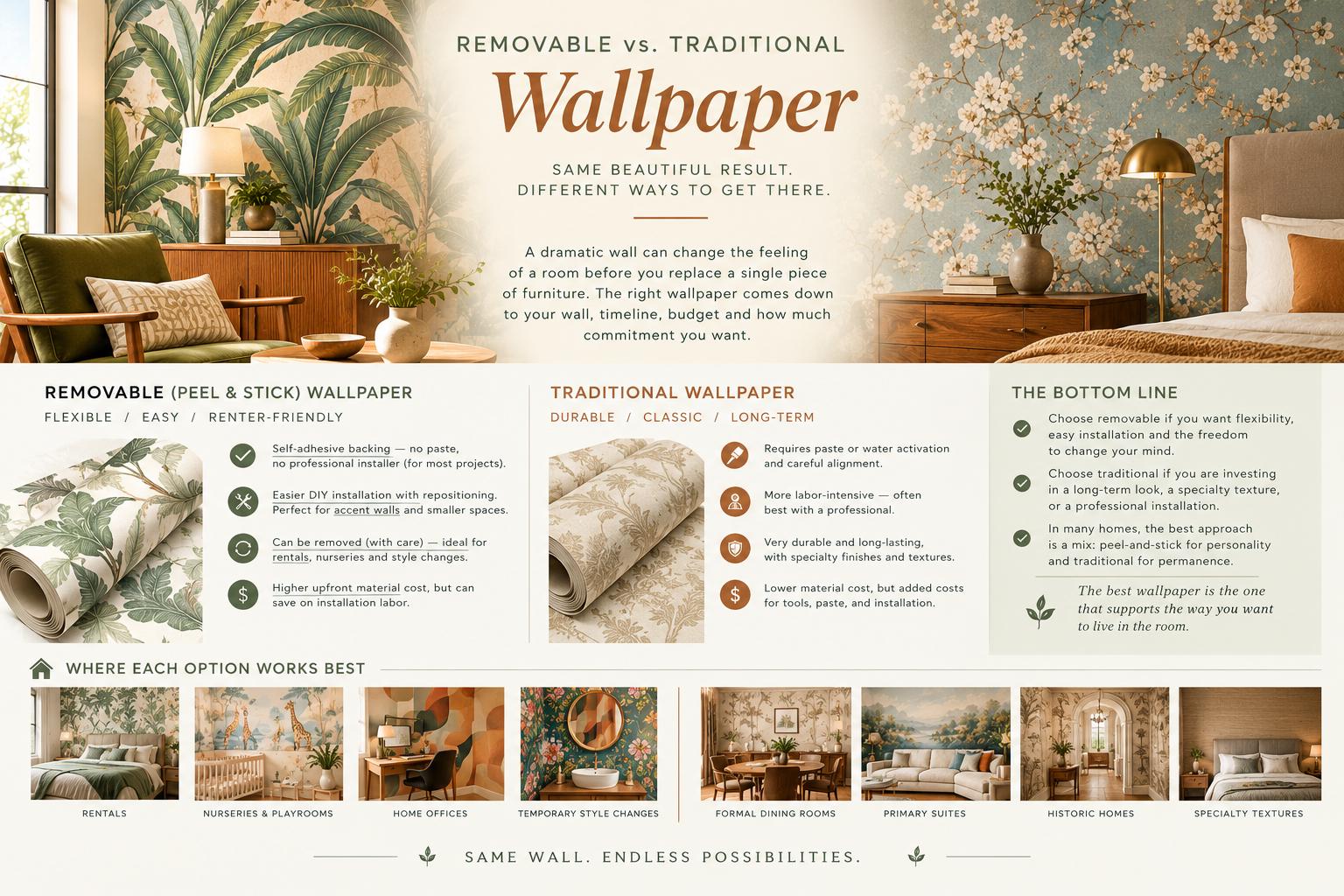
A dramatic wall can change the feeling of a room before you replace a single piece of furniture. The real question is how much commitment you want behind that transformation. In the choice of removable versus traditional wallpaper, the best option depends on your wall condition, timeline, budget, and whether you want the freedom to change your mind later.Peel-and-stick wallpaper gives renters, first-time DIY decorators, and frequent style switchers a practical way to bring in oversized florals, moody botanicals, playful safari scenes, or a personalized nursery mural. Traditional wallpaper still has a place, especially for long-term homes and challenging spaces. Here is how the two compare where it matters most.
Removable Versus Traditional Wallpaper at a Glance
Removable wallpaper, often called peel-and-stick wallpaper, has a self-adhesive backing. You position each panel on a clean, smooth wall, peel away the backing as you go, and smooth it into place. No paste tray, soaking time, or professional installer is required for most projects.Traditional wallpaper arrives unpasted or pre-pasted, depending on the material. It is applied with wallpaper adhesive or activated with water, then carefully aligned and smoothed onto the wall. The process can create a beautiful, durable finish, but it is less forgiving and usually more labor-intensive.The choice is not simply modern versus old-school. It is about matching the material to your project. A renter refreshing a home office has different needs from a homeowner finishing a forever dining room.
Installation: DIY Flexibility or a More Permanent Process?
Peel-and-stick wallpaper is designed for approachable DIY installation. With a measuring tape, level, smoothing tool, and sharp utility knife, many customers can install an accent wall over a weekend afternoon. The panels can be gently lifted and repositioned during application when alignment needs adjustment, which is especially helpful around windows, outlets, and corners.That does not mean removable wallpaper is a shortcut for preparation. Smooth, clean, dry walls are essential. Freshly painted walls should cure fully before installation, and textured walls can prevent the adhesive from making consistent contact. A heavily orange-peeled surface, flaking paint, dusty drywall, or walls with moisture issues are not ideal candidates.Traditional wallpaper also rewards careful prep, but the application itself has more variables. Paste consistency, booking time, seam matching, and paper expansion all affect the result. A confident DIYer can absolutely install it, yet many homeowners choose a professional for a polished finish, particularly in a full room with complicated cuts.For a single statement wall, a peel-and-stick design usually offers the lower-stress path. For a large, permanent installation where professional help is already part of the plan, traditional wallpaper may be a comfortable fit.
Removal and Wall Damage Concerns
The promise of removable wallpaper is appealing for good reason. When applied to a properly prepared smooth wall with sound paint, quality peel-and-stick material can generally be removed by slowly pulling it back at a low angle. This makes it a strong choice for rentals, children’s rooms that will evolve, seasonal refreshes, and homes where your style is still taking shape.Still, “removable” is not the same as risk-free under every condition. Paint that is old, poorly bonded, damaged, or applied without proper primer may lift during removal. The same can happen when wallpaper is installed over a wall that already has peeling paint or surface issues. If you are uncertain, order a sample and test it in a discreet area before committing to a full wall.Traditional wallpaper is meant to stay. Removing it later can involve scoring, steaming, stripping solution, scraping, and potential wall repair. In some cases, the old paper comes away more easily than expected. In others, it becomes a renovation project. That permanence can be worthwhile when you are investing in a look you expect to love for years, but it deserves an honest place in the decision.
Style, Scale, and Customization
Both formats can deliver a high-end look. What changes is the way you can use them in your home.Removable wallpaper is particularly well suited to expressive, room-defining designs. A large-scale watercolor floral behind a bed, a celestial print in a reading nook, or a custom city map in a home office can create the kind of visual impact that paint alone rarely achieves. Because it is easier to change later, it gives you permission to choose a bolder pattern than you might otherwise consider.Custom sizing also changes the experience. Rather than piecing together generic rolls and hoping the repeat lands where you want it, made-to-order panels can be produced to suit your wall measurements. That is useful for an entryway wall, a nursery feature wall, or the focused camera backdrop in a small business workspace.Traditional wallpaper may offer more options in certain specialty substrates and luxury finishes, such as grasscloth, hand-painted papers, or heavily textured materials. These can bring exceptional depth to formal spaces, but they also require realistic expectations about cost, installation, and care. If texture is the central feature of your design plan, traditional wallcovering may offer a broader field.
Cost: Look Beyond the Price of the Roll
Traditional wallpaper can sometimes have a lower material price, especially in standard retail rolls. Yet the total project cost can rise quickly once you add paste, tools, waste from pattern matching, wall prep, and professional installation.Peel-and-stick wallpaper may carry a higher upfront material cost, especially when it is custom-made. In return, you are paying for convenience, tailored dimensions, and a self-adhesive format that can eliminate installation labor for many projects. The value is often clearest in smaller spaces where a single accent wall creates a major change without requiring a full-room renovation.Samples are a worthwhile part of either purchase. Color can shift between a screen and your home’s natural or artificial light. A sample lets you see the scale, finish, and color alongside flooring, furniture, trim, and fabric before ordering a made-to-order wallcovering. It can also help confirm that your smooth wall surface is compatible with peel-and-stick adhesive.
Where Each Option Works Best
Removable wallpaper is often the practical choice for renters, vacation rentals, nurseries, playrooms, home offices, temporary styling, and anyone who wants an elevated look without a permanent renovation. It works beautifully for creating a defined moment: a maximalist powder room, a calming botanical bedroom wall, or a personalized mural that makes a child’s room feel entirely their own.Traditional wallpaper tends to make sense for homeowners committed to a long-term design, rooms with a planned professional installation, or projects where a specialty textured finish is non-negotiable. It can be a strong investment in a formal dining room, historic home, or carefully renovated primary suite.There is also a middle ground. You may choose peel-and-stick for personality-rich areas that are likely to change, then use traditional wallpaper in a space where you want a lasting architectural finish. Your home does not need one rule for every room.
Before You Order Any Wallpaper
Measure the widest and tallest points of your wall, including any areas above doors or around architectural details that you plan to cover. Confirm whether your wall is smooth, clean, dry, and fully cured if recently painted. Then think about the room’s real life: humid bathrooms, energetic kids, pets, rental rules, and how often you enjoy changing your decor.For peel-and-stick projects, buy a sample first when color confidence or wall compatibility is a concern. At WallpaperCraftWorks, designs are made to order, so verifying measurements and choosing a sample before purchase helps you move forward with clarity. Made-to-order products are created specifically for your space, which makes careful planning especially valuable.The best wallpaper is the one that supports the way you want to live in the room. Choose removable when flexibility makes you feel freer to be bold, and choose traditional when permanence is part of the beauty you are building.