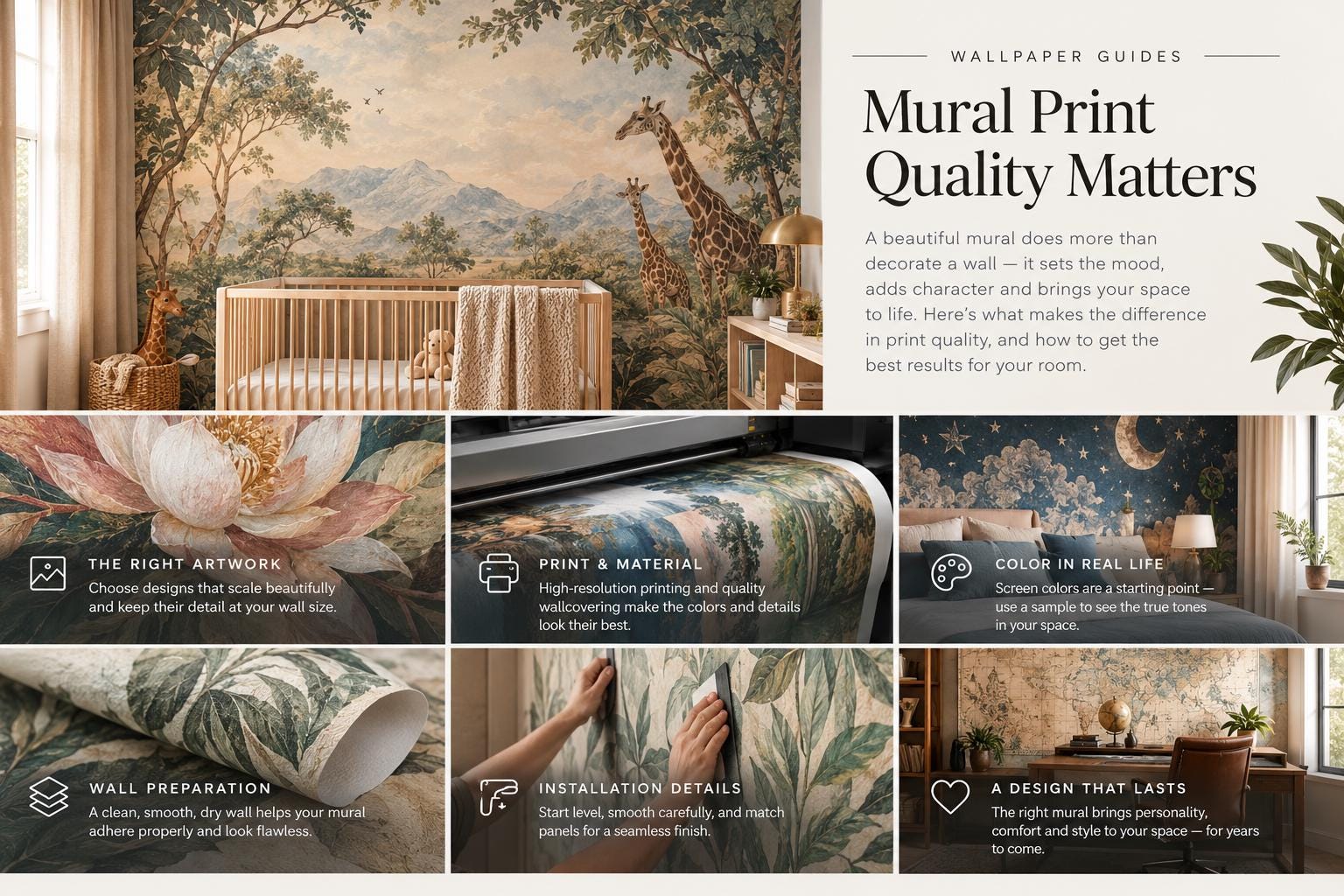
A wall mural can make a compact nursery feel storybook-ready, give a home office real presence, or turn a plain entryway into the moment everyone notices. But mural print quality determines whether that visual impact feels polished up close or falls flat once it is on the wall. The right design, material, image resolution, and wall preparation all play a role in the finished look.For a made-to-order peel-and-stick mural, quality is not only about how vivid the colors appear on screen. It is about how the artwork translates at your exact wall dimensions, how cleanly details reproduce, and how smoothly the finished panels apply. Understanding those details before you order helps you choose a mural you will be excited to live with.
What Mural Print Quality Really Means
Mural print quality is the combined result of the artwork, the printing process, the wallcovering material, and the installation surface. A beautiful botanical mural with fine leaves should still look intentional when viewed from a few feet away. A personalized city map needs readable lines and names. A soft watercolor sky should have gentle variation, not uneven-looking bands of color.Scale matters just as much as sharpness. Artwork designed for a small print can lose clarity when enlarged across an eight-foot wall. On the other hand, an image does not need to look razor-sharp from inches away to work beautifully as wall decor. Murals are usually experienced from across a room, through a doorway, or while sitting on a bed or sofa. The goal is a rich, cohesive image at its intended viewing distance.Printing on peel-and-stick wallpaper also creates a different effect than printing on glossy photo paper. The material has a subtle surface texture and a soft, decorative finish that helps a mural feel like part of the room rather than a giant poster. That is especially appealing for bedrooms, living rooms, nurseries, and rental-friendly accent walls.
Start With Artwork That Suits the Wall Size
The largest factor in a successful mural is using artwork created or prepared for large-format printing. This is particularly important for photographs, custom uploads, and personalized designs. A phone photo may look clear on a screen but contain too little image data for a full-wall installation.Design-led artwork often scales especially well because its composition is made for the format. Oversized florals, abstract washes, celestial scenes, vintage-inspired botanicals, safari illustrations, and repeating luxury-style patterns can retain their visual strength across a broad wall. Their details are meant to be seen as part of a larger composition, not inspected like a tiny photograph.Personalized murals deserve extra attention. Names, initials, quotes, maps, and city designs should have enough contrast to remain legible against the background. Consider where furniture will sit, too. If a crib, headboard, desk, or console table will cover the lower portion of the wall, place the most meaningful text or focal imagery higher up whenever the design allows.
A note on intentional texture
Not every soft edge is a printing problem. Watercolor artwork, painterly florals, aged-map effects, linen-inspired backgrounds, and vintage motifs may include grain, brushwork, faded tones, or distressed details by design. Those qualities create warmth and depth.The key is knowing the difference between intentional artistic texture and a low-resolution image. Intentional texture appears consistent across the artwork. Low-resolution printing can look blocky, fuzzy, or uneven in areas that should have crisp lines, such as lettering, animal eyes, architectural details, or map streets.
Color on Screen Is a Starting Point, Not a Promise
Your phone, laptop, and tablet can all display the same mural differently. Screen brightness, display settings, room lighting, and nearby colors can shift how you perceive a blush floral, deep navy sky, sage green leaf, or warm beige background. A design that looks cool gray on one screen may read warmer in person.This is why samples are one of the smartest steps before ordering a full mural. A sample lets you see the actual print color and material finish in your own space. Tape it to the intended wall and look at it during morning light, afternoon light, and evening lamp light. Hold it near flooring, bedding, cabinetry, and paint colors that will remain in the room.This check is especially useful for rooms where color does the heavy lifting. A moody celestial wall behind a bed, a soft neutral nursery mural, or a high-contrast black-and-cream abstract print can change noticeably depending on the light. Sampling helps you make a confident choice before a custom-sized, made-to-order mural goes into production.
Material and Finish Shape the Final Look
A mural's material influences how colors read and how the wallcovering handles. Peel-and-stick wallpaper is designed for accessible DIY application on suitable smooth walls. Its finish supports a clean, modern decorative look without the wet paste, drying time, or installer coordination associated with traditional wallpaper.Because it is a wallcovering rather than framed art, lighting will affect it differently throughout the day. Very direct sunlight can brighten lighter areas and make dark colors appear less saturated at certain angles. This does not mean you need to avoid a mural in a sunny room. It simply means a sample is helpful, particularly when you are choosing a dark forest scene, a black floral, or a richly colored maximalist pattern.A matte or softly textured appearance is often preferable for interiors because it keeps the focus on the artwork. It also makes murals feel more integrated with painted walls, upholstered furniture, wood tones, and layered decor.
Wall Preparation Protects Print Quality
Even the most beautifully printed mural cannot look its best on a rough, dusty, damaged, or poorly prepared wall. Peel-and-stick material needs a clean, dry, smooth surface for reliable adhesion and a refined finish.Before installation, wipe the wall to remove dust, grease, and residue, then allow it to dry completely. Freshly painted walls need adequate curing time before wallpaper goes up. Paint that feels dry to the touch may not be fully cured, and applying adhesive material too soon can affect adhesion or disturb the paint during removal.Texture is another practical consideration. Light texture can show through a mural, especially in designs with solid colors, pale backgrounds, or fine linework. A busy forest scene or layered floral print may disguise minor texture better than a minimalist mural with large areas of cream or white. If your wall has pronounced orange-peel texture, bumps, cracks, or flaking paint, address that first or choose another surface.
Accurate measurements prevent a compromised design
Measure the wall width and height in several places, not just once. Walls are not always perfectly square, and ceiling lines or baseboards can vary. Ordering to the widest and tallest measurements gives you room for careful trimming during installation.Custom sizing is valuable because it keeps the artwork proportioned for your wall rather than forcing you to piece together generic rolls. When reviewing a design, think about its focal point. A large flower, moon, giraffe, skyline, or monogram should land where it will feel balanced in the room, not hidden behind a door swing or cut off by tall furniture.
Installation Details That Keep the Design Looking Crisp
A clean installation makes a mural feel intentional. Start with a level first panel, because each panel that follows relies on that alignment. Work slowly, smooth from the center outward, and avoid stretching the material. Stretching can distort the artwork and make panel matching more difficult.Good lighting helps you spot bubbles, edges that need smoothing, and pattern alignment as you work. It is often easier to install with two people, especially for larger panels. One person can hold and guide the panel while the other checks alignment and smooths it into place.Panel seams are a normal part of large murals, but careful matching keeps them subtle. Do not rush to trim before you have confirmed the artwork aligns from top to bottom. If your mural has a detailed pattern or personalized text, pause after positioning each panel to make sure the visual flow remains continuous.
Choosing a Design That Will Look Great for Years
The best mural is not always the busiest or boldest one. It is the design that gives the room the mood you want while working with its light, scale, and daily use. A dramatic dark floral can create a boutique-hotel bedroom, while a warm neutral map can make a home office feel personal without becoming distracting on video calls.For a rental or a child's room, peel-and-stick wallpaper offers a lower-commitment way to use expressive color and pattern. For a vacation rental, consider designs that photograph well while still feeling welcoming in person. A large-scale botanical, soft coastal scene, or abstract arch mural can create a memorable backdrop without overwhelming the furniture and layout.WallpaperCraftWorks murals are made to order, so it is worth slowing down before purchase. Confirm your measurements, assess your wall surface, and use a sample when color or texture is a deciding factor. Made-to-order wall decor is not a casual grab-from-the-shelf purchase, but that extra intention is what allows the finished mural to feel tailored to your room.Give the design room to do its job: choose the wall that deserves attention, prepare it carefully, and let the print become the backdrop for the life happening in front of it.