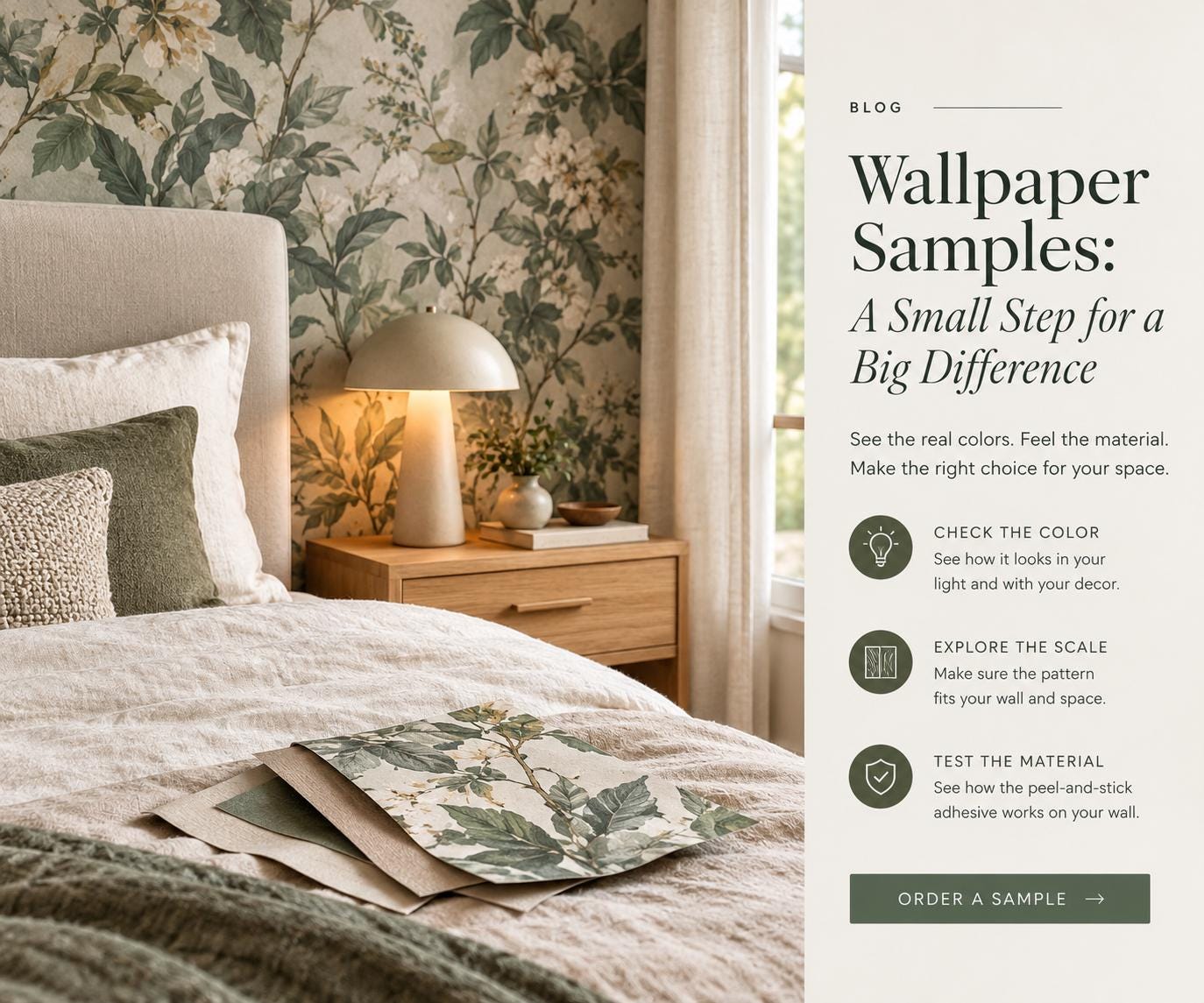
A dramatic botanical behind the bed can make a bedroom feel finished. The same design can look too dark beside your actual oak nightstands, or too cool under a north-facing window. That is why, for most decorating projects, are wallpaper samples worth ordering is an easy question to answer: yes, especially before purchasing made-to-order peel-and-stick wallpaper.A sample is not just a small preview of a pretty pattern. It is your chance to see the material in your room, against your paint color, flooring, furniture, and natural light. It also gives you a practical read on whether your wall is the right surface for self-adhesive wallpaper. For a project meant to create a high-impact accent wall without a major renovation, that bit of certainty is well worth having.
Why wallpaper samples are worth ordering before a custom purchase
Online photos are useful for narrowing down your favorites, but screens are unreliable decorators. A warm beige may appear creamy on one phone and slightly gray on another. Deep green leaves can look nearly black in a dim hallway. Metallic-inspired details, watercolor effects, and layered abstract patterns often have more depth in person than a product image can show.A wallpaper sample lets you judge the design where it will live. Tape it temporarily on the intended wall, then look at it in morning light, afternoon light, and with your lamps on at night. This matters even more in rooms where the mood is the point: a calm nursery, a moody home office, a playful kids' room, or an entryway designed to make an immediate impression.For WallpaperCraftWorks designs, samples also help you experience the peel-and-stick material itself. You can see the finish, feel the thickness, and test how the adhesive behaves on a small, prepared area of your wall. That is much more reassuring than trying to make a final call from a thumbnail image.
Made-to-order wallpaper deserves a little extra confidence
Custom-sized wallpaper and personalized murals are created for your order rather than pulled from a returnable shelf. That allows for a much more tailored result, whether you are covering one narrow wall, framing a reading nook, or adding a name mural above a crib. It also means measuring and material decisions should be made carefully before production begins.A sample cannot confirm every detail of a custom mural layout, but it can confirm the design direction: the color palette, print quality, finish, and material feel. If you are deciding between a dusty floral and a bolder vintage botanical, or between soft safari animals and a more graphic celestial print, a sample makes the choice feel far less abstract.
What a wallpaper sample can tell you
The value of a sample comes from using it deliberately. Before you place your full order, it can answer several of the questions that tend to cause hesitation.
Does the color work with the room?
Hold the sample near the trim, bedding, sofa fabric, cabinetry, and nearby paint. Do not rely only on the wall where you first stick it. Move it around the room and notice which tones become more visible. A blush floral may pull warmer next to ivory curtains, while a navy pattern may feel sharper next to bright white trim.Light changes the answer. Rooms with direct sun can make colors appear brighter and cleaner, while shaded rooms may deepen the same print. If the wall is next to a window, view the sample during the time of day you use the room most. A dining room that comes alive at night should be judged with its dining lights on, not only in midday sun.
Is the scale right for your wall?
A sample reveals pattern size better than a digital mockup, though it has limits. Look at the motif itself. Are the flowers delicate or oversized? Does the abstract movement feel lively or busy? Does a nursery design have the gentle, polished look you wanted from a few feet away?For repeating wallpaper, ask how the design will read across the full wall, not just within the sample. Large-scale patterns can look striking on a single accent wall and may overwhelm a small room if used on every surface. Smaller repeats often feel more subtle, but they can create beautiful texture in a powder room, hallway, or home office.If you are ordering a wall mural, consider the sample as a material and color check rather than a miniature final composition. The finished mural is scaled to your specific wall dimensions, so the overall scene, city map, quote, initials, or personalized name arrangement will be proportioned differently.
Will peel-and-stick wallpaper adhere to your wall?
This is the practical reason samples matter most. Peel-and-stick wallpaper is designed for smooth, clean, dry walls. A small test gives you a chance to evaluate adhesion before committing to a larger installation.Apply the sample to the actual wall whenever possible. Wipe away dust, avoid freshly painted or damp surfaces, and press the sample down smoothly. If your wall has heavy texture, peeling paint, loose drywall paper, or a stain-resistant paint finish that feels especially slick, adhesion may be less predictable. Textured walls can also show through the wallpaper and interrupt the look of fine details.Leave the sample in place long enough to see how it performs in normal room conditions. Then remove it slowly and carefully. This is not a guarantee for every paint type or wall condition, but it is a smart real-world test. It can help renters, homeowners, and vacation-rental hosts feel more comfortable before refreshing a prominent wall.
When you may be able to skip a wallpaper sample
There are a few cases where ordering a sample may not be necessary. If you have already used the same peel-and-stick material successfully on a similar wall in your home, know the color works with your decor, and are choosing a simple repeat pattern for a small project, you may feel ready to order directly.You might also skip a sample when speed matters more than fine-tuning, such as a quick rental refresh or a low-stakes closet makeover. Even then, measure twice and review the wall condition honestly. A fast project is only satisfying when the wallpaper fits and adheres as expected.Still, samples are a small investment compared with replacing a full order that feels wrong once it is installed. They are particularly worthwhile for large walls, dark colors, detailed murals, personalized designs, and rooms with unusual lighting. The more visible the project and the more custom the order, the stronger the case for seeing it first.
How to test a wallpaper sample like a designer
Give your sample a few days rather than making a decision in five minutes. Place it at eye level on the main wall, then check it from the doorway and from the spot where you usually sit. A pattern that feels perfect up close may read differently from across the room.Bring in the items that will share the space. Set your pillow cover, curtain panel, paint swatch, wood finish, or tile sample beside it. This is especially useful if you are building a layered room around the wallpaper instead of treating it as a last-minute accent.For an adhesive test, follow the same common-sense preparation you would use for the finished installation: choose a smooth area, make sure it is clean and dry, and avoid testing over damaged paint or texture. Do not apply it to a surface you already suspect is unsuitable and assume a larger installation will behave differently.Finally, take a photo of the sample in your room. Cameras are not perfect, but comparing a few images taken at different times can help you notice undertones and contrast you missed in the moment. If you keep returning to the sample because it makes the room feel more like yours, that is useful information too.
Samples turn a decorating guess into a confident choice
Wallpaper is one of the fastest ways to give a room a point of view. A wildflower print can soften a guest room. A bold abstract can make a home office feel intentional. A personalized mural can make a child's room feel unmistakably their own. Because the finished effect is so visible, it makes sense to spend a little time confirming the details before ordering.Treat a sample as part of the creative process, not an unnecessary delay. It lets you see whether a design supports the mood you pictured and whether your wall is ready for a smooth DIY application. Once the color feels right, the scale feels exciting, and the material performs well on your surface, you can move forward with a much clearer vision for the room.