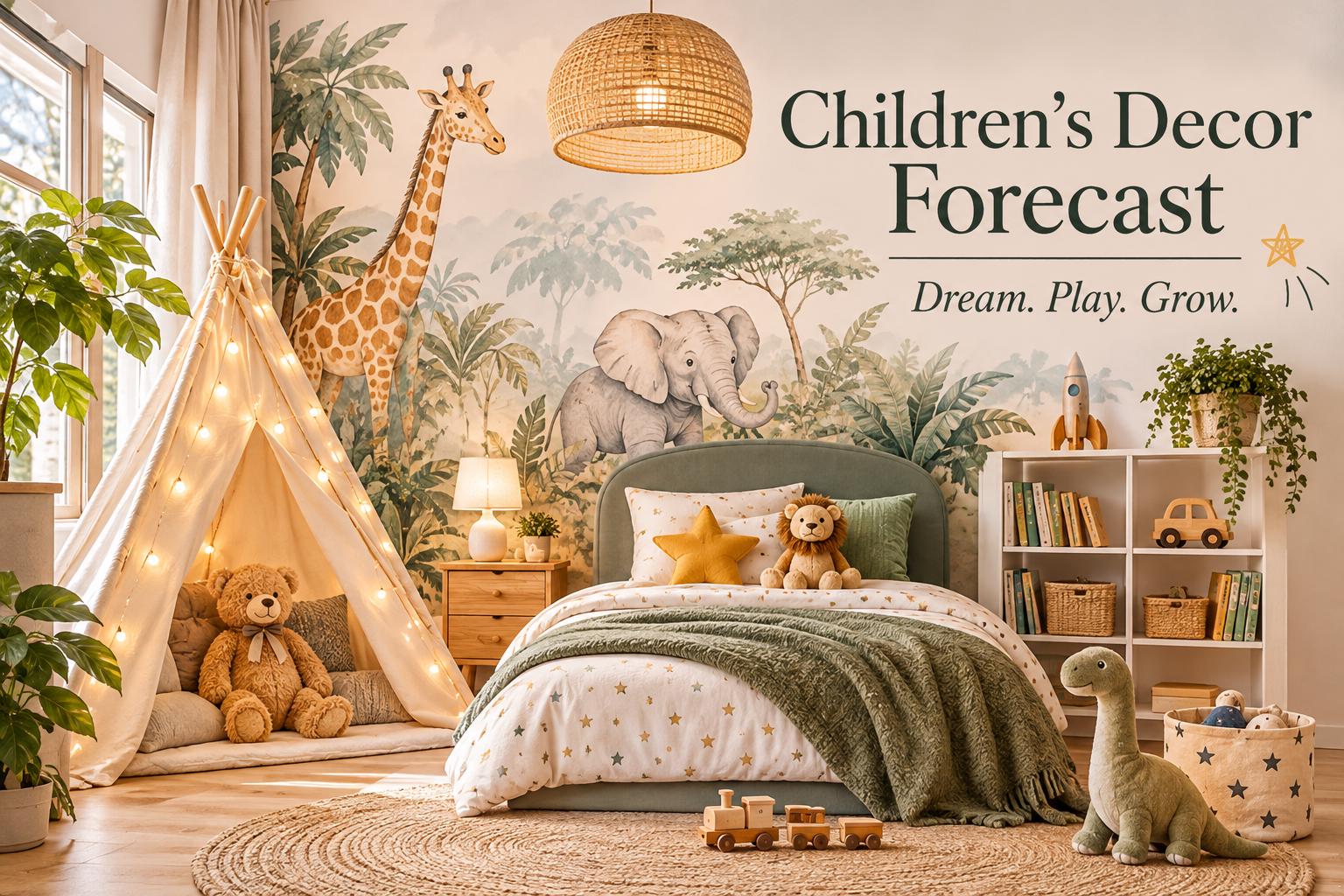
A child’s room can hold a surprising number of jobs: a sleep space, a reading nook, a LEGO headquarters, a rainy-day playroom, and sometimes a quiet reset zone. This children’s decor forecast is less about chasing a passing look and more about choosing walls that make those everyday moments feel more imaginative, organized, and personal.The strongest direction for kids’ interiors is a welcome shift away from overly themed rooms that can feel outgrown in a year or two. Instead, parents are choosing expressive foundations - murals, patterns, and colors that create a mood - then letting bedding, art, storage, and favorite toys bring in the child-specific details. It is a practical approach, especially when a peel-and-stick wallcovering can deliver a major visual change without a full renovation.
The children's decor forecast favors rooms with a point of view
The most memorable children’s rooms are becoming more intentional. That does not mean every object has to match. It means the room has a clear feeling: calm and cloudlike, adventurous and wild, quietly vintage, or bright and creative.For nurseries, that feeling often starts with softened color and illustration-led designs. Think gentle skies, woodland scenes, tiny florals, moon-and-star motifs, or safari animals drawn with a more artistic hand. These designs create a finished backdrop for a crib and glider without requiring a room full of character merchandise.For older kids, the forecast leans toward decor that feels a little less babyish and a little more like a real personal space. A map mural, abstract checkerboard, racing-inspired stripes, celestial print, or oversized botanical can establish the room’s identity while leaving room for evolving interests. A child may move on from dinosaurs or unicorns. A well-chosen color palette or adventure-inspired mural can stay relevant much longer.
Softer palettes are replacing flat pastels
Pastel is not disappearing, but it is becoming more nuanced. Instead of only powder pink, baby blue, or mint, expect to see dusty rose, warm peach, faded denim, mossy green, buttery yellow, clay, soft cocoa, and muted lavender. These shades are playful without looking overly sweet.Earthier colors also help a children’s room relate to the rest of the home. A soft olive botanical wallpaper can work beautifully in a toddler’s room while still feeling polished enough for a hallway-facing space. A neutral animal mural can feel whimsical near a play tent but not visually chaotic when the door is open.The trade-off is light. Deep green, navy, terracotta, and charcoal can make a large room feel cozy, but they may overpower a small or low-light bedroom when used on every wall. In those cases, an accent wall behind the bed, crib, or play table gives the room depth without making it feel closed in.
Playful patterns are becoming more graphic
Children’s decor is moving toward patterns with more confidence. Wide stripes, hand-drawn checks, tiny stars, painterly dots, scallops, and abstract shapes add energy without locking the room into a single character or trend.This is especially useful in shared bedrooms and playrooms. A graphic pattern can bridge different ages and preferences far better than a theme chosen for one sibling. Pair it with flexible furnishings and changeable textiles, and the space can adapt as the children do.Scale matters here. A small, detailed print can feel charming in a nursery or reading corner, while a large-scale mural has more impact on a clear feature wall. If the room already has colorful rugs, open toy storage, or patterned bedding, a simpler wall design may be the better choice. The goal is visual personality, not visual noise.
Personalization becomes part of the architecture
The next wave of personalized decor is more refined than a name sign above the bed. Names, initials, city maps, meaningful quotes, and custom-sized murals are being used as integrated design elements that make a room feel truly belonging rather than merely decorated.A child’s name set within clouds, florals, stars, or a favorite landscape can turn the wall behind a crib into a focal point. For a big-kid room, initials or a map-style mural may offer a more grown-up take on personalization. These choices are particularly effective in rooms with otherwise simple furniture, where the walls can do more of the storytelling.Personalized wallpaper is also a strong option when standard roll sizes would create awkward seams or excess material. Custom sizing lets the design fit the wall you actually have, whether that is a narrow nook between windows, a wall above a daybed, or an under-stair play area.Because personalized and made-to-order wallcoverings are produced specifically for an order, measure carefully before purchasing. Confirm the full wall width and height, account for trim or sloped ceilings, and consider ordering a sample first. A sample gives you a real-world view of color, material texture, and adhesion on your own wall, which is much more useful than judging a design from a screen alone.
The best kids' rooms are designed to evolve
A room does not need to grow up overnight, but it should not need to be completely redone every year either. The children’s decor forecast strongly favors a layered approach: use the wall treatment to establish the atmosphere, then use easier-to-swap pieces to reflect the current phase.For example, a celestial wallpaper can work from nursery through elementary school. In the early years, add a moon-shaped night-light and soft cream textiles. Later, bring in a desk, deep blue bedding, and framed space art. The wall remains useful while the accessories change around it.The same principle works with botanical prints, woodland murals, neutral safari scenes, and abstract patterns. These designs have enough imagination for a child but enough visual sophistication to avoid a forced redesign when tastes shift. It is a more thoughtful use of a decorating budget, especially for families furnishing more than one room.
Choose the wall before choosing the accessories
When a room needs a major refresh, starting with the wallpaper or mural often makes the rest of the process easier. The wall gives you a palette to pull from for curtains, bedding, storage bins, and art. It also prevents the common problem of buying several cute items that do not quite belong together.If your child already owns a beloved bright rug or colorful bedding set, bring that into the decision. A neutral or tonal mural may balance it best. If the furniture and textiles are simple, the wall can carry a bolder pattern. A sample is the easiest way to check whether the printed color works with existing paint, wood tones, and daylight in the room.
DIY-friendly walls still require the right preparation
Peel-and-stick wallpaper is appealing because it gives a room high visual impact without pasted wallpaper or professional installation. For renters and families who prefer a less permanent decorating route, that flexibility can be a major advantage. But easy installation starts with the right surface.Smooth, clean, dry walls are the best fit for self-adhesive wallcovering. Textured walls, peeling paint, dusty surfaces, fresh paint that has not fully cured, and high-humidity areas can affect adhesion and the finished appearance. A mural also looks best when the wall is measured accurately and panels are applied with care, starting from a level vertical edge.For a child’s room, plan the accent wall around daily life. The wall behind a bed or crib is a natural choice because furniture protects some of the lower area from fingerprints and busy play. A reading nook, play kitchen corner, or wall above a dresser can also become a small but high-impact moment. You do not need to cover every wall to make the room feel transformed.
Let the room feel like theirs, not like a showroom
The most useful forecast is also the simplest: children’s rooms are becoming warmer, more personal, and less disposable. A polished space can still have stuffed animals on the floor, artwork taped to a door, and a basket full of books that never quite stays organized.Choose a wall design that sets the mood you want your child to feel when they walk in - curious, comforted, adventurous, or calm. Then leave enough room for the everyday pieces that make the space genuinely theirs.