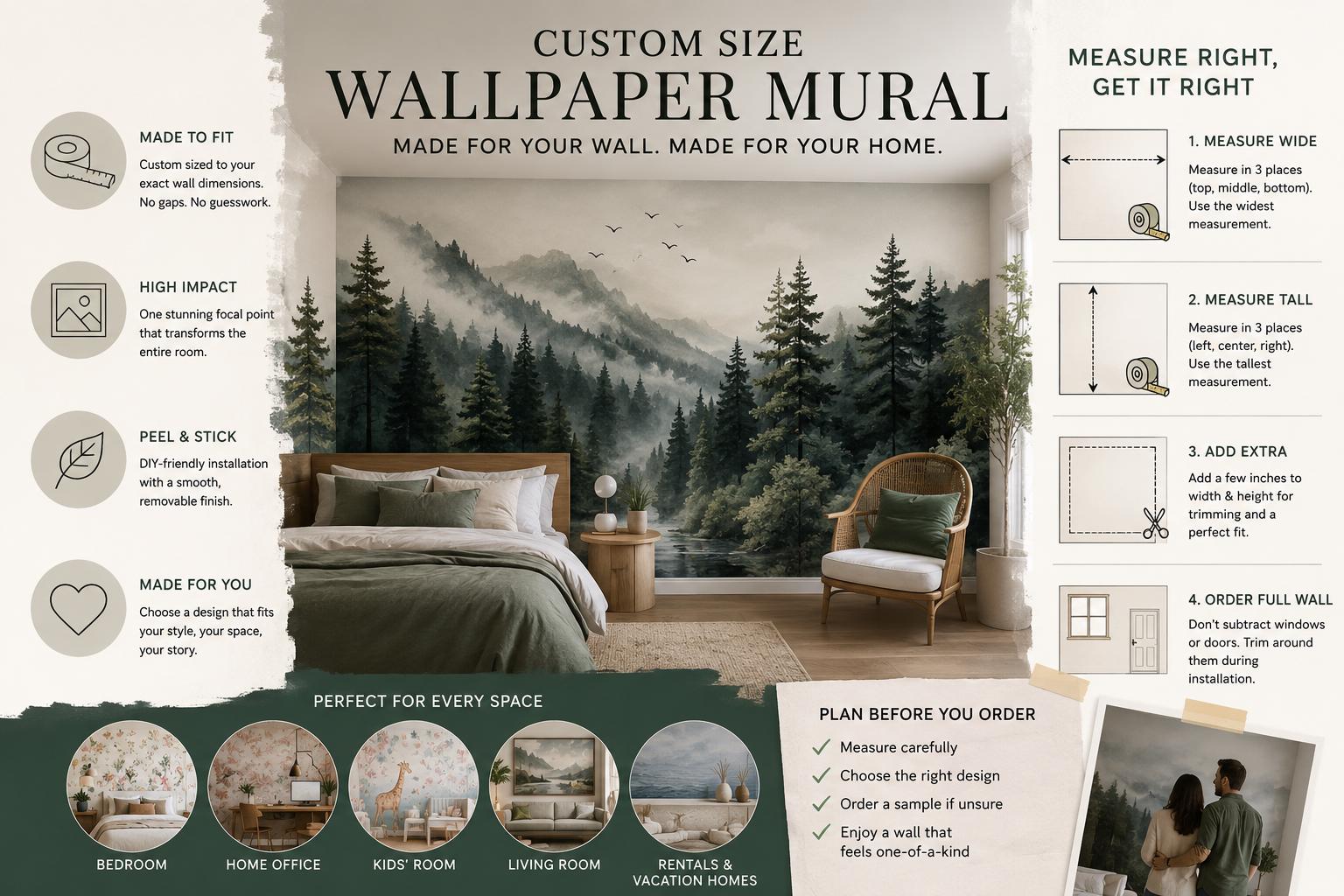
A mural should feel like it was made for the room, not squeezed into it. That is the advantage of a custom size wallpaper mural: your artwork can fill the wall you actually have, whether it is a narrow nursery nook, a tall stair landing, or the statement wall behind a king-size bed.Unlike standard wallpaper rolls, a made-to-order mural is scaled to your submitted dimensions. You are not trying to make a repeated pattern work around an awkward window or settling for a design that stops short of the ceiling. With the right measurements, a peel-and-stick mural creates a polished, high-impact backdrop while keeping installation within reach for a confident DIY project.
Why a Custom Size Wallpaper Mural Changes the Room
A large wall has visual weight. Leaving it blank can make a room feel unfinished, while filling it with several small pieces of art can sometimes create more visual noise than intention. A mural gives the eye one clear focal point. A misty forest can add calm to a bedroom, oversized botanical leaves can bring energy to a dining space, and a personalized map or name design can make a child's room feel truly their own.Custom sizing matters because rooms are rarely as tidy as product photos suggest. Walls may have uneven ceilings, baseboards, window trim, built-in shelving, or outlets in exactly the wrong place. Ordering to your wall dimensions gives you material to trim at the edges, which is much more forgiving than trying to stretch a fixed-size design across a larger area.It also lets the artwork work at the right scale. In a small powder room, a dramatic floral can feel immersive rather than overwhelming when it is designed for one wall. In a living room with high ceilings, a properly sized celestial or abstract mural can make use of that vertical space instead of looking like a framed poster that happened to grow larger.
How to Measure for a Custom Size Wallpaper Mural
Measuring is simple, but it is the part of the project worth slowing down for. Made-to-order murals are produced specifically for the dimensions provided, so confirming the numbers before placing an order protects both the finished look and your budget.
Measure the widest and tallest points
Use a metal tape measure and measure your wall's width in three places: near the top, across the middle, and near the bottom. Record the widest measurement. Then measure the height on the left, in the center, and on the right, using the tallest measurement.Walls and ceilings can be slightly out of square, even in newer homes. Measuring only once may leave you short on material at one edge. The widest and tallest measurements give your mural the coverage needed for a clean finish.
Add extra material for trimming
Add a few inches to both your width and height before ordering. This extra allowance is there for real-world conditions: a ceiling that slopes slightly, a baseboard that is not perfectly level, or a wall corner that drifts. Once the mural is installed, the excess can be carefully trimmed for a crisp edge.Do not subtract windows, doors, or other cutouts from your overall wall size. Order for the full wall, then trim around those features during installation. This keeps the artwork aligned and avoids the risk of a gap if a measurement is off.
Treat angled walls and obstacles as part of the plan
For a wall with a sloped ceiling, measure to the highest point. For a staircase wall, measure the full bounding rectangle rather than following every angle. You will trim away the unused portions after installation.If a wall includes a large built-in, fireplace surround, or multiple windows, pause and consider the design placement. A full mural can still work beautifully, but a wallpaper sample and a quick sketch of the wall help you decide where the most detailed part of the art should land. You may prefer a design with a softer all-over composition rather than one with a single centered subject that could be interrupted by a window.
Choose a Design That Suits the Wall's Job
The best mural is not only beautiful on screen. It supports the mood and purpose of the room.A bedroom wall behind the bed can handle a more expressive design because the furniture grounds the lower section of the mural. Moody florals, antique-inspired garden scenes, soft clouds, and deep celestial prints all create a restful focal point without asking you to decorate every other wall.In a home office, a custom mural can define the work zone, especially in a multipurpose room. Consider a refined abstract, architectural city scene, or neutral botanical design that looks thoughtful during video calls but does not compete with your focus. For a vacation rental, a mural can provide the memorable detail guests photograph and remember, whether that is a coastal landscape, a desert-inspired pattern, or a local city map.Children's spaces offer room for more playfulness. Safari animals, storybook skies, whimsical florals, and personalized name murals can grow with a room when the color palette feels intentional rather than overly themed. For a nursery, look at the mural from both standing height and the crib area. Softer colors and larger shapes tend to feel calm, while small dense details can read busier from across the room.Scale is the deciding factor. Large-scale art feels confident on a broad, uninterrupted wall. A smaller wall may benefit from a design with an airy background or a pattern that does not rely on one oversized central motif. If you are unsure how a color or texture will read in your lighting, order a sample first. It is the easiest way to see the print alongside your flooring, paint, textiles, and natural light before committing.
Peel-and-Stick Works Best on the Right Surface
Peel-and-stick wallpaper is designed to make decorative transformation more accessible, but the wall surface still matters. For best adhesion, install on a smooth, clean, dry, properly cured wall. Fresh paint needs time to cure fully before wallpaper goes up. Installing too soon can affect adhesion and may damage the paint if the mural is removed later.Textured walls are the biggest variable. Light, smooth texture may work in some cases, but heavy orange peel, knockdown texture, brick, unfinished drywall, or porous surfaces can prevent the adhesive from making consistent contact. A sample is especially useful when your wall has any texture or an unfamiliar paint finish.Before installation, wipe the wall free of dust, grease, and residue, then allow it to dry completely. Remove outlet covers and switch plates if they fall within the mural area. This creates a neater result and makes trimming around the openings easier.
Install With Patience, Not Pressure
A peel-and-stick mural is manageable for many DIY decorators, but large walls are easier with two people. One person can hold the panel aligned at the ceiling while the other gradually removes the backing and smooths the material downward. Start with the first panel carefully. It sets the alignment for every panel that follows.Work from top to bottom, pressing the mural onto the wall in small sections rather than pulling all the backing away at once. Use a smoothing tool to guide out air bubbles as you go. If you notice a panel beginning to drift, gently reposition it early instead of hoping the next panel will correct it.Avoid stretching the material. The goal is a relaxed, flat application with properly matched panel edges. Once every panel is in place, trim excess material along ceilings, baseboards, corners, windows, and outlets with a sharp blade. Replace outlet covers only after the trimming is complete.
Plan Before You Order
Because a custom mural is made to order, careful planning is part of the purchase. Confirm your wall measurements, choose the design and scale that suit the space, and consider a sample when color, texture, or adhesion is uncertain. Made-to-order wallcoverings are generally not returnable simply because dimensions or design preferences changed, so a few minutes spent measuring and visualizing now makes the project far more satisfying later.At WallpaperCraftWorks, the goal is not to make your room look like everyone else's. It is to give one wall enough personality to change how the whole space feels. Measure generously, choose a design you will enjoy seeing every day, and let that blank wall earn its place in the room.