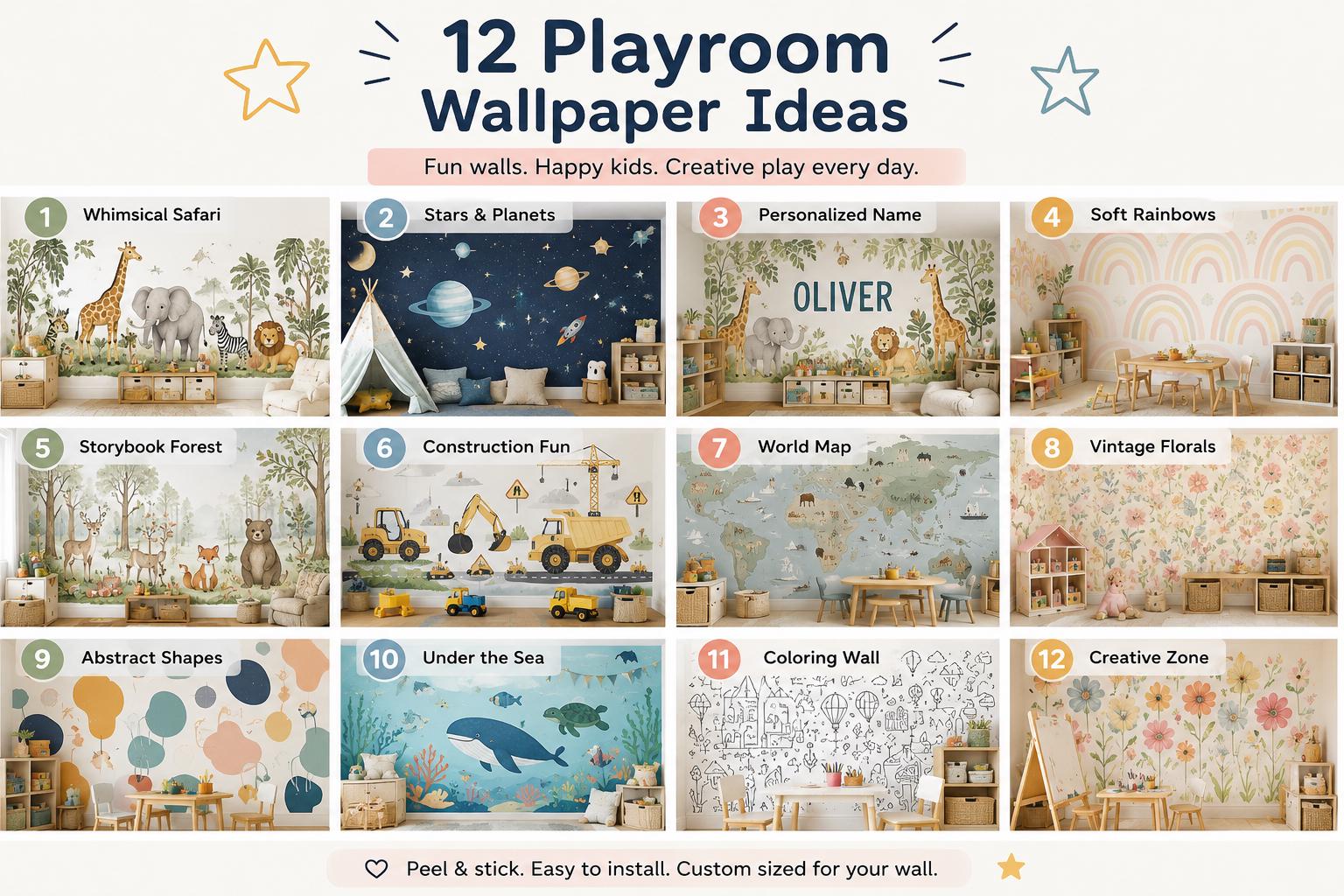
A playroom is one of the few spaces in a home where a wall can be unapologetically joyful. The best playroom wallpaper design examples do more than fill empty space - they set a scene for blocks, books, costumes, and the everyday mess of creative play. With peel-and-stick wallpaper, that big visual shift does not have to mean a permanent renovation.The right choice depends on how your child uses the room, how long you expect the design to stay in place, and whether the room also needs to feel calm at the end of a busy day. These ideas balance imagination with real-life decorating decisions, from custom sizing to smooth-wall installation.
Playroom wallpaper design examples for every kind of play
1. Whimsical safari animals
Safari wallpaper brings instant character without requiring a room full of themed furniture. Think illustrated giraffes, elephants, monkeys, and lions set among palms or soft jungle foliage. It works especially well behind a reading nook, toy kitchen, or play table because the wall creates a natural backdrop for the activity zone.For a softer look, choose animals in muted clay, sage, tan, or warm gray. Brighter primary colors feel more energetic, but they can compete with colorful toys. A custom-made mural lets the artwork fit the wall rather than forcing you to crop the scene around standard roll widths.
2. A sky full of stars and planets
Celestial wallpaper is playful without feeling overly young, which makes it a smart option for a room that needs to grow with a child. Deep navy skies, hand-drawn planets, constellations, and moons give the space a sense of wonder while still pairing easily with natural wood, white storage, and neutral rugs.This design is particularly effective on the wall behind a low bed or soft floor cushions. If the room gets limited daylight, consider a lighter blue or creamy background instead of an all-dark mural. You still get the magic of outer space without making the room feel enclosed.
3. Personalized name murals
A child’s name integrated into a mural turns a playroom into a space that feels genuinely theirs. A name can appear among clouds, florals, jungle animals, maps, or a favorite color palette. This approach is ideal for shared-use spaces where you want the playroom to feel intentional rather than like an overflow area for toys.Personalization does ask for more certainty than a generic print. Check spelling, capitalization, and the placement of windows, outlets, and furniture before ordering. Because made-to-order wallpaper is created specifically for your wall, a sample and accurate measurements are worth the extra step.
4. Soft rainbow arches
Rainbow arches are a versatile choice for toddlers and young children, especially when done in dusty pastels, terracotta, oatmeal, and blush rather than saturated colors. The pattern has movement but does not feel busy, making it easy to layer with colorful bins, framed art, and open shelving.An all-over rainbow print is often more forgiving than a large-scale mural in a room with several doors or a lot of wall interruptions. It can also transition beautifully from a nursery into a playroom or bedroom, extending the life of the design.
5. Storybook forest scenes
Woodland wallpaper suits families who like a cozy, collected home rather than a cartoon-heavy children’s room. Painted trees, mushrooms, foxes, bears, and tiny woodland details offer plenty for little ones to notice during play while creating a polished backdrop for adults.Look for a forest scene with an open composition, especially in a smaller room. Dense dark trees can feel dramatic and beautiful, but they may overwhelm a playroom with low ceilings or limited natural light. A cream, pale green, or soft blue ground keeps the look airy.
6. Construction vehicles and roads
For children who arrange toy cars by the hour, a road or construction-themed wall can become part of the play itself. Excavators, cranes, dump trucks, city streets, and traffic signs create an engaging setting near a vehicle table or floor mat.The trade-off is specificity. A bold truck design may be exactly right for the current obsession, but tastes can change quickly. To keep the room flexible, use the themed wallpaper on one accent wall and choose solid-color storage, curtains, and rugs that can stay as interests evolve.
7. A world map made for little explorers
Map murals make a playroom feel educational without turning it into a classroom. Illustrated continents, animals, landmarks, and oceans give parents an easy prompt for conversations about places, wildlife, and travel. They also work well in a playroom that doubles as a homework or craft space.Maps with softer colors tend to blend into a home’s wider decor more easily than brightly labeled schoolroom maps. If you are working around a narrow wall, choose a custom-sized design so important features are not lost at the edges.
8. Vintage-inspired florals
Florals may not be the first idea that comes to mind for a playroom, but they create a charming, imaginative backdrop for dollhouses, art tables, and dress-up corners. Small-scale florals in vintage pink, butter yellow, lavender, or blue feel warm and playful without becoming overly precious.This is also a strong choice for a shared playroom used by children of different ages. Rather than centering the room on one character or activity, floral wallpaper gives the space personality while leaving room for each child’s toys and interests.
9. Abstract shapes in a happy color palette
Abstract wallpaper with squiggles, dots, arches, checks, or painted brushstrokes offers the energy of a children’s space with a more design-forward finish. It is a good fit for parents who want the playroom to connect visually with the rest of their home.Keep scale in mind. Oversized shapes can make a compact room feel larger and more graphic, while small, tightly repeated patterns can read as busy when shelves and toys are already in view. If the playroom has open storage, a larger, simpler pattern usually creates more breathing room.
10. Under-the-sea scenes
Ocean murals bring color and movement to an active playroom. Whales, sea turtles, coral reefs, fish, and gentle waves work especially well where children play on the floor, since the mural makes the entire room feel like an environment rather than just a decorated wall.A watercolor ocean scene has a calmer effect than a high-contrast cartoon print. For a long wall, choose a panoramic mural that carries the underwater scene across the room. Measure the full width and height at several points, then use the largest measurements when ordering custom wallpaper.
11. Black-and-white coloring-wall wallpaper
A black-and-white illustrated design can be surprisingly practical. It gives the room a creative, graphic edge while allowing toys, books, and colorful furniture to become the color story. Cities, animals, outer space, and botanical doodles all work in this style.This option is useful for renters or for anyone hesitant to commit to a strong palette. It feels intentional on its own, yet it can be refreshed with new bins, art, or textiles as your child’s preferences change. Just remember that removable peel-and-stick wallpaper performs best on clean, smooth, fully cured walls.
12. A mural that defines a creative zone
Not every playroom needs wallpaper on every wall. A single mural behind an easel, play kitchen, reading bench, or craft table can establish a dedicated zone and make an ordinary corner feel complete. Clouds above a reading nook, a cityscape behind building toys, or painted flowers behind an art station all give the room a clear visual purpose.This is often the most practical route for a multipurpose room. You get high impact with less material, and the remaining walls can stay quiet enough for storage, artwork, and the realities of family life.
How to choose wallpaper that works beyond the first year
Start with the room’s strongest use case. A room devoted to imaginative play can handle a more theatrical mural. A space that also hosts guests, schoolwork, or family movie nights may benefit from a softer pattern that reads as decor first and children’s design second.Then consider the wall itself. Peel-and-stick wallpaper is designed for accessible DIY application, but surface preparation matters. Smooth, clean, dry walls provide the best adhesion. Fresh paint should be fully cured before installation, and heavily textured walls can affect both the finished appearance and how well the material holds.Samples are especially useful for playroom projects. Colors shift with daylight, lamps, flooring, and nearby furniture, and a small sample lets you assess the material texture and adhesion on your own wall. It is a simple way to feel more confident before ordering a made-to-order design.WallpaperCraftWorks designs are custom sized for the wall, helping you avoid the awkward repeats, excess trimming, and partial scenes that can come with generic rolls. Measure carefully, account for the highest and widest points, and decide whether you want the pattern centered behind a key piece of furniture or carried across the full wall.A playful wall should give your child something to look at, invent stories around, and eventually outgrow without turning the room into a renovation project. Choose the scene that makes the space feel more like theirs now, while leaving enough flexibility for whatever they love next.