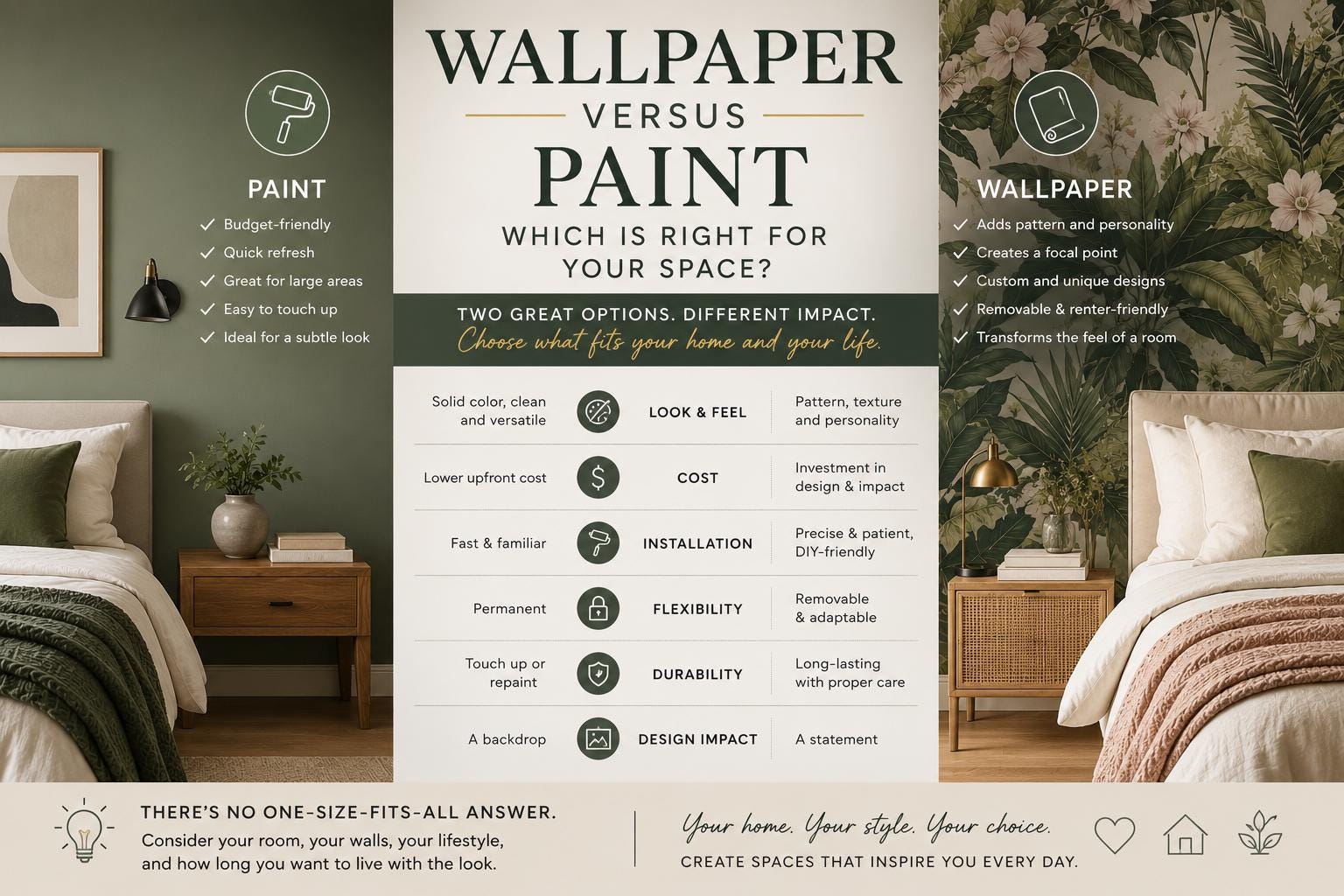
A gallon of paint can change a room’s color. A patterned wall can change its entire point of view. That is the real decision behind wallpaper versus paint: not simply which finish costs less at checkout, but which one creates the mood, flexibility, and level of visual impact your space needs.For a calm rental bedroom, a lively nursery, a polished home office, or an entryway that deserves more than a neutral coat, both options have a place. The better choice depends on the room, the condition of the walls, how long you plan to live with the look, and whether you want the wall treatment to be a backdrop or the main design moment.
Wallpaper Versus Paint: Start With the Look You Want
Paint is excellent when color is the whole story. A warm white can make a dark room feel lighter, a muted green can soften a bedroom, and a deep navy can add drama without competing with furniture or art. It is a clean, adaptable choice for large spaces and for homes that benefit from a quiet visual foundation.Wallpaper brings another layer to the room: pattern, scale, texture, and personality. A botanical print can make a guest room feel collected and romantic. A geometric design can give a home office more energy and structure. A personalized map, name mural, or celestial scene can turn a child’s room into something that feels distinctly theirs.This difference matters most in rooms where you want a finished, styled feeling without adding many extra decor pieces. One accent wall in a rich floral, abstract, or safari pattern can do the work of a gallery wall, statement rug, and color palette all at once. Paint can be bold, but wallpaper can introduce visual detail that a solid color cannot replicate.That does not mean every wall needs a print. Full-room wallpaper can be beautiful in a powder room, nursery, dining nook, or small bedroom, especially with a softer repeating pattern. In an open living room or a space with busy furnishings, an accent wall may be the better balance. Paint the remaining walls in a color pulled from the wallpaper to make the room feel intentional rather than crowded.
Cost Depends on More Than the Initial Purchase
At first glance, paint often appears to be the budget option. For a standard room with walls in good condition, paint, primer, tools, and a weekend of DIY work can be less expensive than covering the same space with wallpaper. If you are refreshing several rooms in one neutral shade, paint can be especially economical.The comparison changes when wall prep and design impact enter the picture. Paint may require patching, sanding, priming, multiple coats, and touch-ups, particularly when you are covering a dark color or an uneven finish. Professional painters add labor costs quickly. Traditional pasted wallpaper can also involve professional installation, adhesives, and a more complicated removal process.Made-to-order peel-and-stick wallpaper is priced as a decorative wallcovering rather than a basic wall color, but it can reduce some of those added steps. Because it is custom sized for your wall, you can order for the dimensions you actually need rather than trying to make generic rolls work. Its self-adhesive backing also makes it a practical DIY option for smooth, properly prepared walls.A sample is worth considering before you commit to a full order. It lets you view the color in your own lighting, feel the material, and check how the design works beside flooring, trim, textiles, and furniture. It is a small planning step that can prevent a costly color mismatch or a pattern choice that feels different at wall scale.
Installation: Quick Painting or a Precise Wallpaper Project?
Painting is familiar to most homeowners and renters. Protect the floor, tape the trim, cut in around edges, roll the walls, and allow the paint to dry. It is approachable, though it can be messier and more time-consuming than expected, especially in rooms with high ceilings, textured surfaces, dark existing colors, or detailed trim.Peel-and-stick wallpaper asks for a different kind of care. The wall should be smooth, clean, dry, and fully cured if it has been freshly painted. Dust, moisture, peeling paint, heavy texture, and uneven surfaces can interfere with adhesion. Accurate wall measurements also matter, particularly around windows, doors, outlets, and sloped ceilings.The application itself is manageable for many DIY decorators, but patience is part of the process. Start with a level first panel, align the pattern as you go, smooth outward to release air, and trim carefully at the edges. A second set of hands can make large panels easier to position. The result is often far more dramatic than the amount of work suggests, but it is not a shortcut for skipping surface preparation.If your walls are heavily textured or damaged, paint may be the more dependable solution until the surface is repaired. Peel-and-stick wallpaper performs best on smooth walls, and setting that expectation upfront helps ensure your finished wall looks as polished as the design itself.
Flexibility Matters for Renters and Changing Tastes
For renters, paint can be complicated. Many leases limit color changes, require written approval, or expect walls to be repainted before move-out. Even when a landlord permits it, returning a bold room to its original neutral can mean another round of work and expense.Removable wallpaper offers a different path for renters who want to make a temporary space feel personal. A moody vintage floral behind the bed, a soft cloud mural in a nursery, or a tailored striped wall in a home office can make the room feel less borrowed. When properly applied to a suitable surface, peel-and-stick wallpaper is designed to be removed without the permanence of traditional paste.Homeowners benefit from that flexibility, too. A child’s interests change. A home office becomes a guest room. A maximalist moment may eventually give way to a calmer palette. Choosing a removable wallcovering means you can enjoy a strong design choice now without treating it as a forever renovation.Still, removable does not mean risk-free in every situation. Wall condition, paint quality, how long the paint has cured, and prior surface damage all affect removal. If you are working in a rental or on a wall with uncertain paint history, test a sample in an inconspicuous area and review your lease requirements first.
Durability and Everyday Upkeep
Painted walls are easy to understand: scuffs can often be cleaned or touched up, and a new coat refreshes the room when the finish begins to look tired. High-traffic areas such as hallways, mudrooms, and kitchens may benefit from a durable, washable paint sheen selected for that purpose.Wallpaper can also be a smart choice for rooms that need personality without constant redecorating. A quality pattern disguises some minor marks more effectively than a flat, light-colored painted wall, and a detailed print can make a space feel finished even with simple furniture. For a home office, guest room, nursery, or vacation rental feature wall, that visual payoff can be especially useful.The key is to match the material to the room’s demands. Avoid treating a decorative peel-and-stick wallcovering like a scrubbable commercial surface. Follow care guidance, clean gently when needed, and consider paint for areas exposed to frequent moisture, grease, or hard daily wear.
Choose Paint When the Room Needs a Quiet Foundation
Paint is often the better fit when you are covering a large area on a tight budget, working with textured walls, refreshing a room before selling, or aiming for a subtle background that lets art and furnishings lead. It is also a practical answer when you need to repair imperfect walls first or when a high-moisture space calls for a specialty paint finish.Choose wallpaper when the wall itself should become part of the decor. It is especially compelling for an accent wall, an entry, a nursery, a bedroom headboard wall, a dining space, or a small commercial-style setting such as a creative office or vacation rental. Custom sizing and personalized designs give you room to make the treatment feel specific to the space rather than pulled from a generic shelf.
The Best Choice Can Be Both
You do not have to choose one finish for the entire home. Some of the most livable rooms pair painted walls with one wallpapered focal point. Paint can keep the palette grounded, while wallpaper brings the character: soft botanicals behind a bed, a black-and-gold abstract in a workspace, a storybook safari in a playroom, or a custom city map in an entryway.Before ordering or opening a paint can, stand in the room at different times of day. Notice where the light lands, what the wall is competing with, and what you wish the space said about you. The best wall finish is the one that makes the room feel more like home every time you walk in.