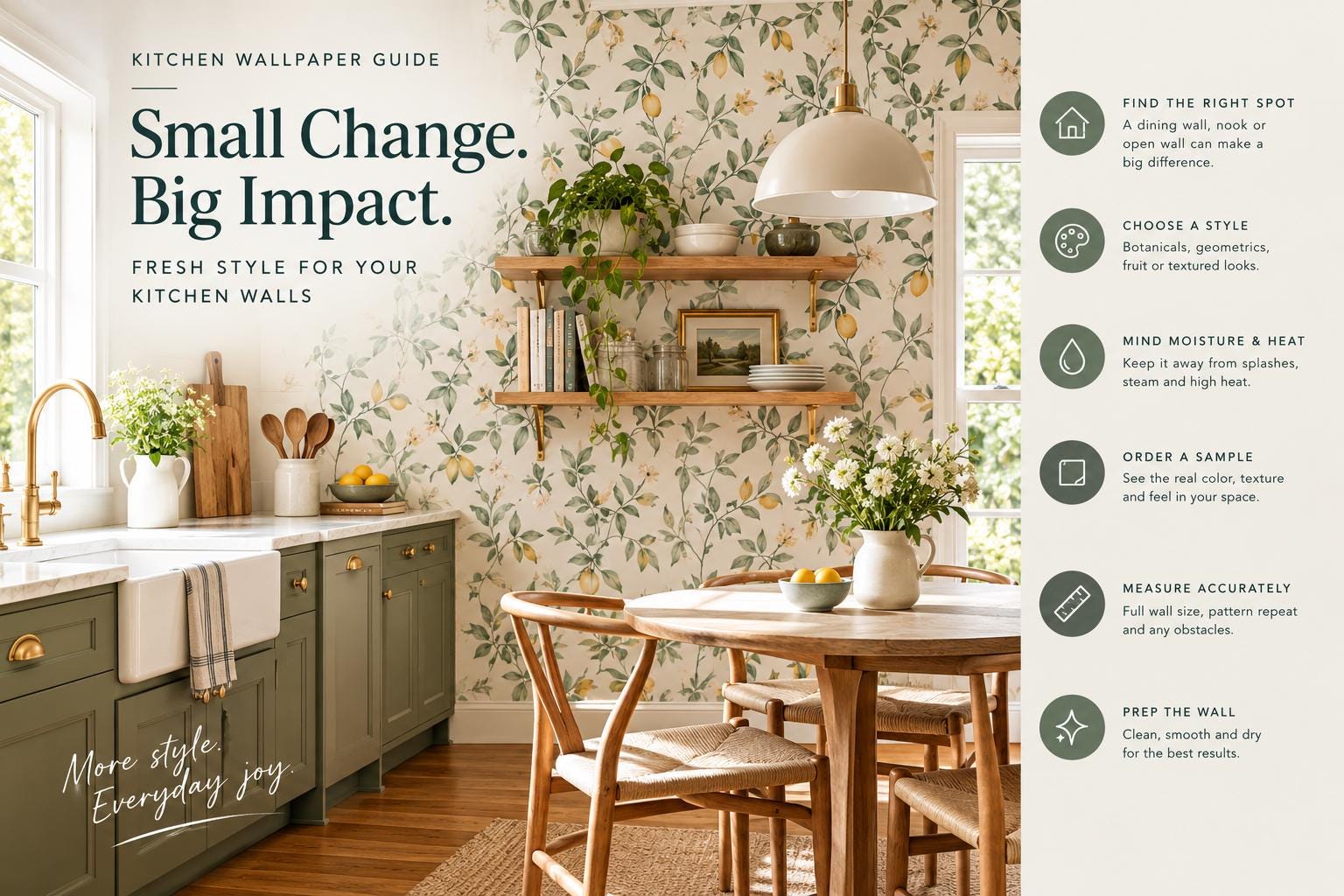
A kitchen can have beautiful cabinets, good lighting, and new hardware yet still feel a little too plain. Kitchen wallpaper changes that quickly. A painted wall offers color, but wallpaper adds scale, movement, and a point of view - whether that means delicate vintage botanicals, a clean geometric print, cheerful fruit, or a quiet textured look that lets a statement backsplash shine.For homeowners, renters, and anyone refreshing a vacation rental, peel-and-stick wallpaper makes that change feel far more approachable. The right design can turn an unused breakfast nook into a favorite seat, give a coffee corner its own identity, or make a compact galley kitchen feel intentionally designed rather than merely functional.
Where Kitchen Wallpaper Makes the Biggest Impact
Not every kitchen wall needs a pattern. In fact, wallpaper often looks best when it has room to be noticed. A dining wall, breakfast nook, pantry door surround, or open wall above a sideboard can become a natural focal point without competing with cabinetry, appliances, and tile.If your kitchen has a large blank wall, a mural-scale botanical or soft abstract pattern can bring visual depth to the room. In a smaller kitchen, a small-repeat print is often easier to live with because it creates interest without making the walls feel crowded. Light backgrounds can help a compact space feel open, while darker grounds add drama and make brass, wood, and white cabinetry stand out.The wall behind open shelving is another strong option. A wallpapered backdrop turns everyday glassware, cookbooks, and ceramics into part of the display. Just keep in mind that shelves will cover portions of the pattern, so choose a design that still looks appealing in fragments rather than relying on one large central motif.
Choose a Kitchen Wallpaper That Works With the Room
Start by looking at the fixed finishes you are not planning to replace. Cabinet color, countertops, backsplash tile, flooring, and hardware should guide the wallpaper choice. A warm cream cabinet may look especially inviting with soft green or muted floral wallpaper, while crisp white cabinets can handle bolder navy, black, terracotta, or colorful graphic prints.Pattern scale matters as much as color. Large flowers, palm leaves, or oversized abstract shapes make a confident statement on a full wall or in a roomy eating area. Small florals, fine stripes, and subtle geometrics tend to suit tighter spaces, especially when there are several cabinet breaks, windows, or doors.Consider the feeling you want at the table, too. A vintage botanical print can soften a modern kitchen. A citrus or food-inspired design feels playful and welcoming. A refined marble-look or neutral linen-style pattern can create a more polished, luxury-inspired setting without asking the room to be overly formal.There is no rule that kitchen wallpaper must match every finish exactly. A little contrast often makes a space more memorable. The goal is connection: repeat one or two tones already present in the kitchen, then let the wallpaper introduce a fresh accent color or pattern.
Think Carefully About Moisture, Heat, and Splashes
Peel-and-stick wallpaper is designed for smooth, clean, dry interior walls. It is a great fit for many kitchen zones, but placement matters. Avoid installing it directly behind a cooktop, inside a shower-like wet area, or where it will receive frequent heavy splashes. High heat, steam, grease, and repeated scrubbing are hard on any decorative wallcovering.For walls near a sink or range, it depends on the layout and how protected the surface is. A wallpapered breakfast wall across the room is an easy choice. A narrow strip directly behind the sink is better reserved for a durable backsplash material. Choosing the right location helps your design stay beautiful longer and gives you less to worry about during everyday cooking.
Samples Make Color Decisions Easier
Screens are useful for browsing, but they cannot show exactly how a wallpaper color will read next to your cabinets under your kitchen lighting. Daylight can pull out one undertone, while warm evening bulbs can pull out another. A sample lets you see the actual material texture, printed color, and adhesive performance before ordering the full size.Place a sample on the intended wall and look at it in the morning, afternoon, and evening. Hold it next to countertop samples, paint swatches, cabinet doors, or a favorite serving bowl. This simple step can save you from choosing a white that reads too cool, a green that feels too yellow, or a pattern that is larger than expected.Samples are especially helpful for made-to-order wallpaper. Because each order is produced to your selected dimensions, taking time to confirm the design is a smart part of the process. It gives you more confidence before purchasing a custom-sized, non-returnable wallcovering.
Measure for a Better-Fitting Kitchen Wall
Measure the full width and height of the wall at its widest and tallest points, even if windows, outlets, or cabinets interrupt the area. Wallpaper is generally printed for the full wall space, then trimmed around obstacles during installation. Measuring only the visible open sections can leave you without enough material for clean cuts and proper alignment.For a simple rectangular wall, record the width and height in inches. For walls with a sloped ceiling, angled soffit, or unusual shape, measure the widest and tallest overall area and use a quick sketch to note any details. If you are unsure, a slightly more generous measurement is safer than coming up short.Do not forget to account for pattern repeat. A repeating design needs extra material at the top or side so motifs line up from panel to panel. Custom sizing takes much of the guesswork out of ordering compared with generic rolls, but accurate wall dimensions are still essential.
Prepare the Surface Before You Start
The best installation begins before the first panel reaches the wall. Peel-and-stick wallpaper adheres most reliably to smooth, properly cured, clean surfaces. Wipe away dust, grease, and kitchen residue, then let the wall dry fully. Freshly painted walls need adequate cure time before wallpaper installation, since paint that has not fully cured can affect adhesion.Textured walls, flaking paint, porous surfaces, and areas with active moisture are less predictable. If your kitchen wall has noticeable orange-peel texture or deep surface variation, test with a sample first. The smoother the wall, the cleaner the finished look and the easier it will be to reposition panels during application.When you are ready to install, work slowly rather than pulling away all the backing at once. Start at the top, check that the first panel is straight, and smooth downward in sections. Use a smoothing tool to press out air as you go. Small adjustments early on are much easier than trying to correct a full panel after it has been applied.
Styling Ideas Beyond the Main Wall
Kitchen wallpaper does not have to cover an entire room to earn its place. Use it on the wall around a pantry, within a built-in dining nook, or behind a freestanding hutch for a custom furniture effect. In an open-concept home, wallpaper can also visually define the eating area without adding a physical divider.For a rental-friendly refresh, choose one wall with clear visual presence and keep the surrounding finishes simple. A peel-and-stick design can bring personality to a temporary home while avoiding the disruption of traditional paste wallpaper. If your plans change later, removable wall decor gives you more flexibility than a permanent renovation.WallpaperCraftWorks designs are made to order, which makes it easier to select dimensions for the wall you actually have rather than trying to make standard rolls work around your kitchen. That practical detail is what allows a decorative idea to feel tailored, even when the installation is a DIY weekend project.The best kitchen wallpaper is not necessarily the loudest print or the safest neutral. It is the one that feels at home with your cabinets, holds up to how you use the room, and gives you a small moment of pleasure every time you pour coffee, set the table, or walk through the door.